

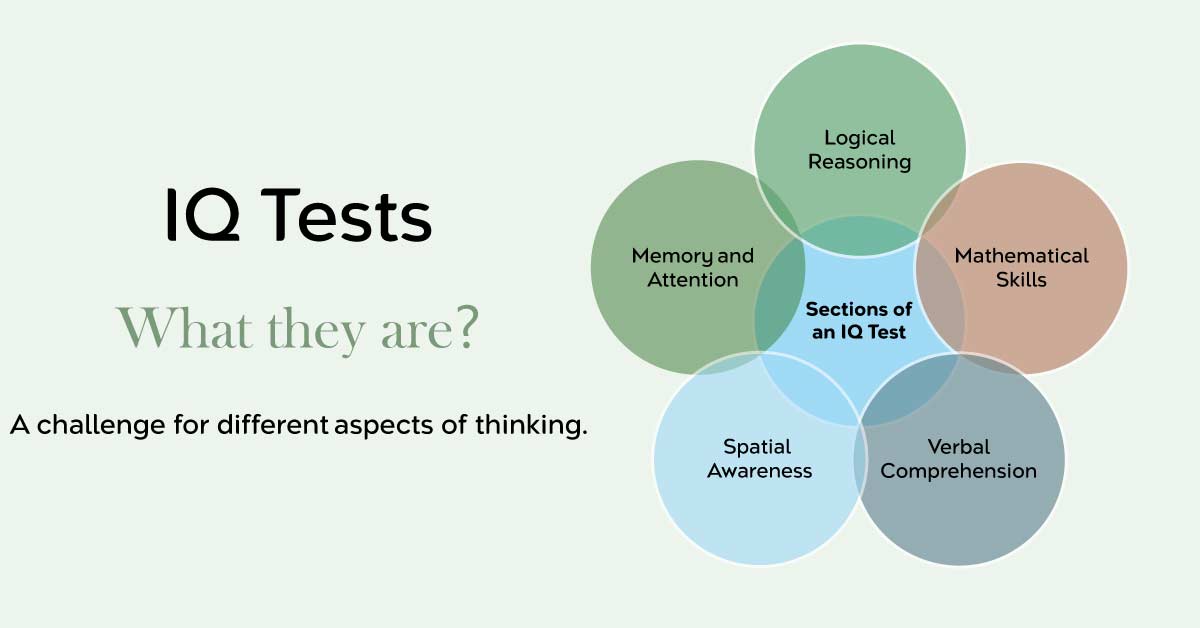
In addition to challenging all aspects of your thinking, IQ tests are designed to interactively assess and stimulate mainly different cognitive skills.
These tests do not measure simple theoretical knowledge, but analyze the way you think, reason and solve new problems. On an IQ test site, each test becomes an opportunity for self-knowledge and personal development and offers a more complete picture of a person's intellectual potential.
Logical Reasoning
Logical reasoning is one of the most important components of an intelligence test. Logical reasoning exercises assess the ability to identify patterns, make connections between information, and draw correct conclusions based on given data. In online intelligence tests, this type of reasoning is often tested through series of figures, deduction problems, or abstract logic questions. These exercises help develop analytical thinking and problem-solving skills.
Mathematical Skills
The mathematical skills tested in an intelligence test refer to both rapid calculations and logical thinking applied to numbers. Mathematical skills problems require the ability to understand numerical relationships, to estimate correctly, and to apply mathematical rules in various situations.
These exercises are essential for assessing a person's quantitative thinking and analytical ability, and are frequently found in IQ tests.
Verbal Comprehension
As an important element in the assessment of general intelligence, verbal comprehension represents the ability to understand and interpret language and is closely related to abstract thinking and communication skills. Intelligence tests targeting this area may include verbal analogies, vocabulary exercises, sentence completion, or identifying the correct meaning of words.
Spatial Perception
Spatial perception is the ability to visualize objects and relationships between shapes in space. Intelligence tests often include mental rotation exercises, pattern recognition, or figure completion.
In fields such as engineering, architecture, design, or spatial orientation, but also in everyday activities, this ability is particularly important.
Memory and Attention
Memory and attention play a key role in intellectual performance. Tests that assess these aspects measure the ability to concentrate, retain information in the short term, and process information quickly.
A good memory and high attention significantly contribute to achieving better results in online intelligence tests.
IQ Tests As A Mental Exercise
On an IQ test website, these exercises can also be viewed as mental training. They offer users the opportunity to test their cognitive abilities, compare their results, improve their performance over time, and prepare for interviews in their future career.
Online IQ tests are accessible, interactive, and suitable for anyone who wants to put their mind to the test.
Conclusion
Intelligence tests are a balanced combination of logic, mathematics, language, visual thinking, memory and attention. They do not define a person's worth, but rather provide insight into how their thinking works.
Seen as an intellectual challenge, online intelligence tests can become a useful tool for self-knowledge, personal development and mental stimulation.
While an IQ test measures an individual’s cognitive capacity and thinking strengths, psychometric tools like the Enneagram personality test look inward to map a person’s underlying motivations, desires, and fears.
Unlock your mind and discover your true potential—take our Free Classical IQ test today!
Frequently Asked Questions
1. How do memory and attention interact during learning?
Attention acts as a filter that selects information from your environment. Memory then captures and stores that selected information for future use. If you do not pay attention first, your brain cannot encode the information into your memory.
2. Do mathematical skills only involve calculation?
Mathematical skills require much more than basic arithmetic. You need logical reasoning to map out the steps of a problem. You also need spatial perception to visualize shapes, understand geometry, and recognize abstract patterns.
3. Why is spatial perception important in everyday life?
Spatial perception allows you to understand how objects fit together in physical space. You use it constantly to navigate traffic, read maps, and judge distances while parking. It is also crucial for physical tasks like packing bags or assembling furniture.

