

Career Aptitude Tests vs IQ Tests: What's the Difference?
Published on: July 07, 2026
By : Ariadna Miles
Career Aptitude Tests vs IQ Tests
Introduction
Many people assume that career aptitude tests and IQ tests are essentially the same thing. After all, both assessments evaluate abilities and are often used to help individuals understand their strengths.
However, career aptitude tests and IQ tests serve different purposes and provide different types of information.
An IQ test focuses primarily on cognitive ability and reasoning skills, while a career aptitude test takes a broader approach by considering interests, personality traits, work preferences, and abilities to identify suitable career paths.
Understanding the differences can help you choose the right assessment and gain more meaningful insights about your future.
What Is an IQ Test?
An IQ (Intelligence Quotient) test is designed to measure cognitive abilities related to reasoning, problem-solving, and learning.
Modern IQ tests commonly assess:
- Logical reasoning
- Numerical reasoning
- Pattern recognition
- Abstract thinking
- Spatial reasoning
- Verbal reasoning
The goal is to estimate a person's intellectual abilities relative to the general population.
IQ scores are often used in educational, research, and professional contexts to evaluate cognitive potential.
What Is a Career Aptitude Test?
A career aptitude test is designed to identify careers that align with your strengths, interests, abilities, and work preferences.
Rather than focusing solely on intelligence, career aptitude assessments typically evaluate:
- Interests
- Personality traits
- Work preferences
- Communication styles
- Motivations
- Problem-solving abilities
The objective is to provide practical career recommendations that match an individual's overall profile.
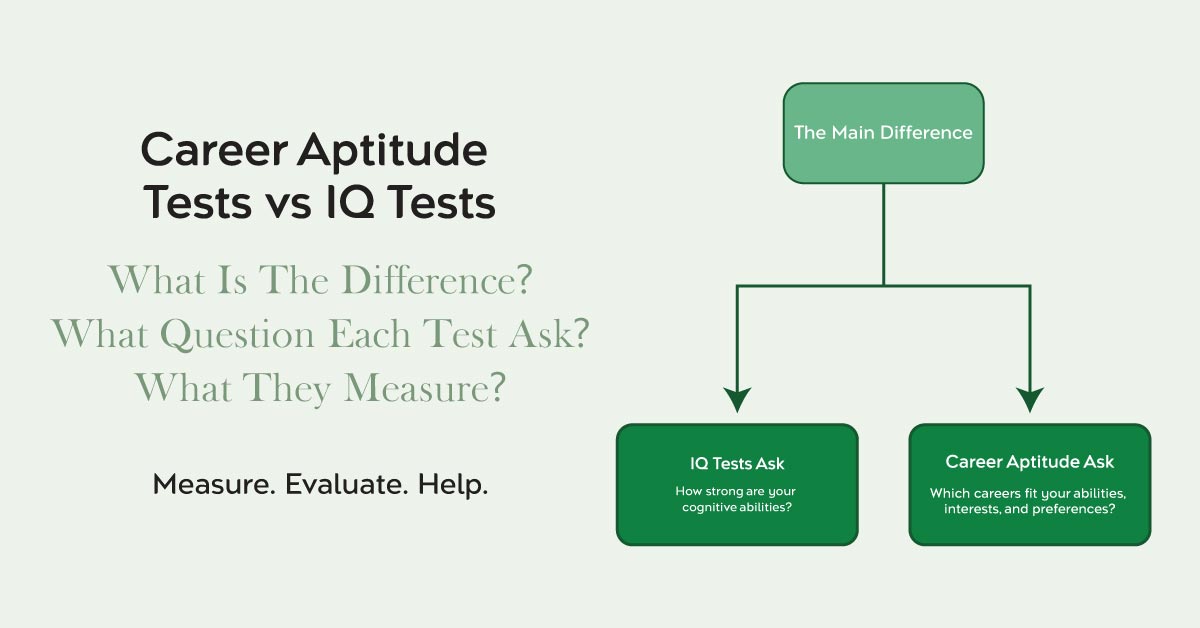
The Main Difference
The simplest distinction is:
IQ Tests Ask:
"How strong are your cognitive abilities?"
Career Aptitude Tests Ask:
"Which careers fit your abilities, interests, and preferences?"
An IQ test measures potential in specific reasoning areas.
A career aptitude test helps translate personal strengths into possible career paths.
What Does an IQ Test Measure?
IQ tests primarily focus on intellectual abilities.
Common areas include:
Logical Reasoning
The ability to identify patterns, relationships, and rules.
Numerical Reasoning
Working with numbers, calculations, and quantitative information.
Spatial Reasoning
Visualizing objects and understanding spatial relationships.
Verbal Reasoning
Understanding language and drawing conclusions from written information.
These abilities are often associated with learning, problem-solving, and performance in intellectually demanding environments.
What Does a Career Aptitude Test Measure?
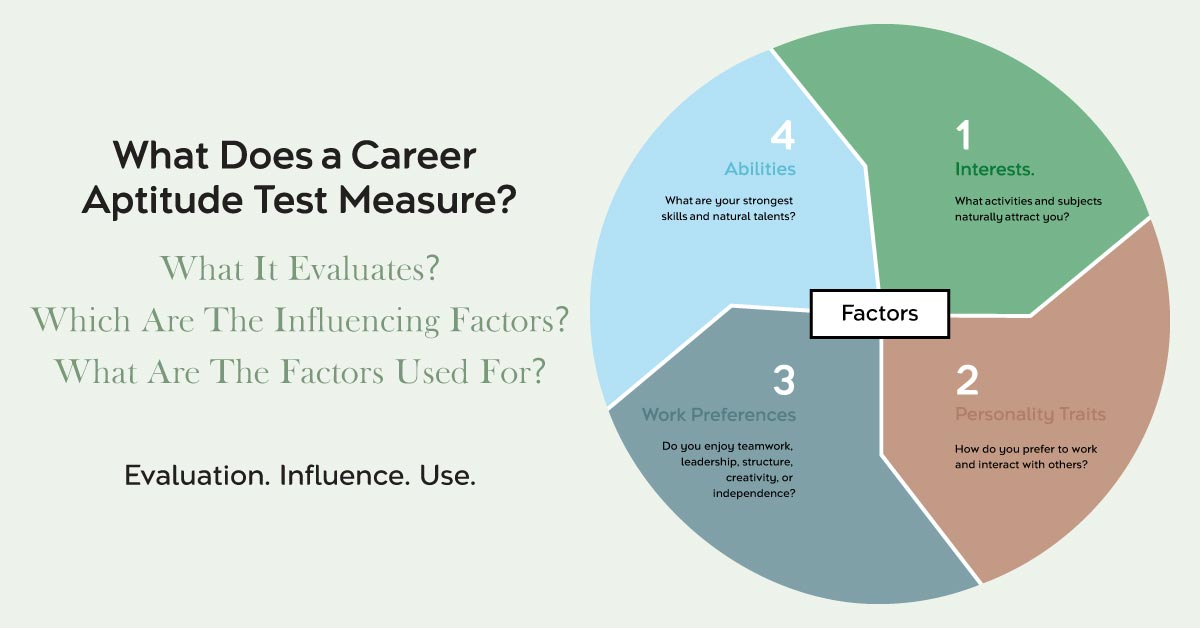
Career aptitude tests evaluate a wider range of characteristics.
Interests
What activities and subjects naturally attract you?
Personality Traits
How do you prefer to work and interact with others?
Work Preferences
Do you enjoy teamwork, leadership, structure, creativity, or independence?
Abilities
What are your strongest skills and natural talents?
Combining these factors allows career assessments to generate personalized career suggestions.
Can IQ Predict Career Success?
IQ can influence performance in certain professions, particularly those requiring advanced problem-solving, analytical thinking, or technical expertise.
Examples include:
- Engineering
- Data science
- Software development
- Scientific research
- Finance
However, career success depends on many additional factors:
- Motivation
- Communication skills
- Emotional intelligence
- Persistence
- Interests
- Work ethic
For this reason, IQ alone cannot determine whether someone will succeed in a particular career.
Why Career Aptitude Tests Provide Broader Guidance
Imagine two people with identical IQ scores.
One enjoys working with people.
The other prefers technical problem-solving.
Although their cognitive abilities may be similar, they may thrive in completely different careers so this a good reason to answer the question: why take a career aptitude test ?
A career aptitude test helps identify these differences by evaluating additional characteristics beyond intelligence.
This often makes career aptitude assessments more useful for career planning and it depends on how accurate is a career aptitude test.
When Should You Take an IQ Test?
An IQ test may be useful if you want to:
- Measure cognitive strengths
- Assess reasoning abilities
- Prepare for cognitive assessments used by employers
- Better understand intellectual strengths and weaknesses
IQ testing can provide valuable insights into how you process information and solve problems.
When Should You Take a Career Aptitude Test?
A career aptitude test may be useful if you want to:
- Choose a career path
- Select a college major
- Explore new professions
- Change careers
- Better understand your strengths and interests
These assessments are designed specifically to support career decision-making.
Should You Take Both?
In many cases, yes.
An IQ test can provide valuable information about cognitive strengths.
A career aptitude test can help identify careers that align with those strengths while also considering interests, personality traits, and work preferences.
Together, these assessments provide a more complete picture of your potential.
More than that, a personality test taken together with an IQ test and a career aptitude test, reveals your natural preferences, communication style, behavioral tendencies and clearly reveals the differences between career aptitude tests vs personality tests as well as career aptitude tests vs iq tests.
Conclusion
IQ tests and career aptitude tests are valuable tools, but they answer different questions.
An IQ test helps measure cognitive abilities such as logical, numerical, spatial, and verbal reasoning. A career aptitude test helps identify careers that match your interests, strengths, personality, and abilities.
For career planning, aptitude assessments generally provide more practical guidance. However, combining career aptitude testing with IQ testing can offer deeper insights into your strengths and future opportunities.
Ready to discover careers that match your strengths, interests, and abilities? Take our Career Aptitude Test and explore your future possibilities.

