

Career Paths for Highly Conscientious People
Published on: September 05, 2026
By : Ariadna Miles
Career Paths for Highly Conscientious People
Introduction
Some people naturally enjoy planning, organising, following through on commitments, and working toward clearly defined goals. They may prefer structured environments where responsibilities are clear and where careful, consistent work is valued.
These characteristics are often associated with conscientiousness, one of the five broad dimensions of personality in the Big Five personality model.
Highly conscientious people may be organised, dependable, detail-oriented, persistent, and focused on completing tasks effectively. These characteristics can be useful in many professional environments, particularly roles that involve planning, responsibility, accuracy, or long-term goals.
However, being highly conscientious does not mean that someone is limited to a particular type of career. Career choice also depends on interests, abilities, personality, values, education, experience, and preferred work environment.
In this guide, we'll explore career paths that may appeal to highly conscientious people, the strengths associated with conscientiousness, and how to use personality insights when exploring career options.
What Does It Mean to Be Highly Conscientious?
Conscientiousness is a personality trait associated with qualities such as organisation, responsibility, self-discipline, persistence, and goal-oriented behaviour.
People who score relatively high in conscientiousness may tend to:
- Plan ahead
- Pay attention to details
- Follow through on commitments
- Set goals
- Meet deadlines
- Organise their work
- Prefer clear expectations
- Work consistently toward objectives
- Take responsibilities seriously
These characteristics can be valuable in many different professional settings.
However, conscientiousness exists on a spectrum. People can also be highly successful while having different approaches to organisation, structure, and planning.
How Conscientiousness Can Influence Career Preferences
Personality may influence the types of work environments people find comfortable or satisfying.
Highly conscientious individuals may prefer careers that provide:
- Clear responsibilities
- Defined objectives
- Organised workflows
- Measurable outcomes
- Opportunities for planning
- Consistent expectations
- Responsibility and accountability
For some people, having clear goals and being able to see progress toward those goals can be particularly motivating.
Others may enjoy combining structure with creativity, flexibility, or collaboration.
This is why conscientiousness should be viewed as one factor in career exploration rather than a system for assigning people to careers.
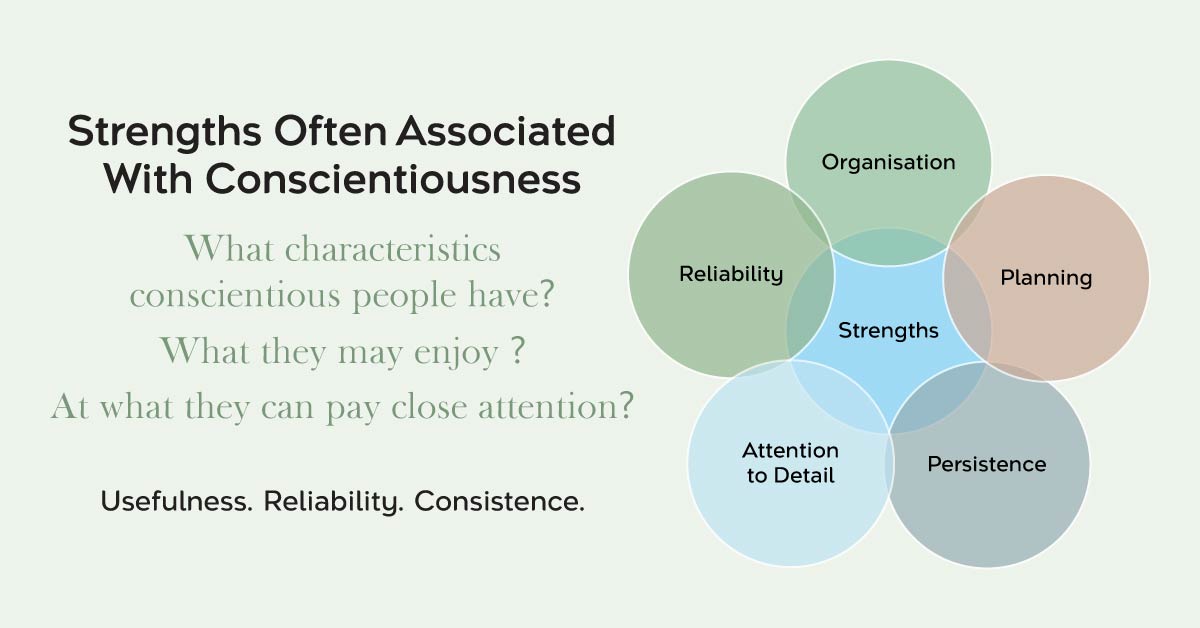
Strengths Often Associated With Conscientiousness
Highly conscientious people may bring several useful characteristics to the workplace.
Organisation
They may enjoy organising tasks, information, schedules, and projects.
This can be useful in roles involving coordination, administration, project planning, and operations.
Reliability
Conscientious individuals may place a strong emphasis on meeting commitments and completing responsibilities.
Reliability can be valuable in virtually any professional environment.
Attention to Detail
Some highly conscientious people may naturally pay close attention to accuracy and small details.
This can be particularly useful when mistakes can have significant consequences.
Persistence
Conscientiousness is often associated with working consistently toward long-term goals.
This may be helpful in careers that require patience, preparation, and sustained effort.
Planning
People with higher conscientiousness may enjoy creating plans and organising steps toward a particular objective.
Planning can be useful in management, finance, engineering, healthcare, education, and many other fields.
Career Paths That May Suit Highly Conscientious People
There is no single list of careers that is appropriate for everyone with high conscientiousness.
However, some career areas may naturally appeal to people who enjoy structure, responsibility, planning, and attention to detail.
Accounting and Finance
Accounting and finance careers often involve working with financial information, following procedures, analysing data, and maintaining accuracy.
Potential roles include:
- Accountant
- Financial analyst
- Auditor
- Financial controller
- Tax specialist
- Budget analyst
People who enjoy structured tasks and detailed financial information may find these environments appealing.
Project Management
Project management involves coordinating people, resources, schedules, budgets, and deadlines.
Typical responsibilities include:
- Creating project plans
- Tracking progress
- Managing deadlines
- Coordinating teams
- Identifying risks
- Communicating with stakeholders
These responsibilities may appeal to people who enjoy organisation and goal-oriented work.
Engineering
Engineering involves applying technical knowledge and problem-solving to design, develop, test, or improve systems and products.
Depending on the field, engineers may work with:
- Technical specifications
- Mathematical models
- Design processes
- Testing procedures
- Safety requirements
- Quality standards
The combination of structured problem-solving and technical detail may appeal to some conscientious individuals.
Healthcare
Many healthcare professions require preparation, responsibility, attention to detail, and adherence to established procedures.
Potential career paths include:
- Physician
- Nurse
- Pharmacist
- Medical laboratory professional
- Radiologic technologist
- Healthcare administrator
Healthcare roles vary significantly, and each requires specific qualifications and skills.
Law
Legal work often involves analysing information, researching cases, preparing documents, following procedures, and paying close attention to details.
Potential roles include:
- Lawyer
- Legal researcher
- Compliance specialist
- Paralegal
- Contract specialist
People who enjoy structured information and careful analysis may find some legal careers appealing.
Operations and Administration
Operations and administrative roles often involve organising processes, coordinating activities, maintaining records, and ensuring that tasks are completed efficiently.
Potential roles include:
- Operations manager
- Administrative manager
- Office manager
- Operations coordinator
- Process specialist
These careers can provide opportunities to use planning and organisational strengths.
Quality Assurance
Quality assurance involves checking whether products, services, or processes meet defined standards.
Work may involve:
- Testing
- Documentation
- Process reviews
- Identifying errors
- Monitoring standards
- Improving procedures
Attention to detail and consistency can be useful in these environments.
Data and Research
Research and data-related careers may involve collecting information, analysing results, documenting findings, and following systematic processes.
Potential roles include:
- Data analyst
- Research analyst
- Market researcher
- Statistician
- Research coordinator
Some roles in this area also require strong mathematical or technical abilities.
Education
Teaching involves planning lessons, organising materials, monitoring progress, and working toward learning objectives.
Teachers may also need to:
- Manage schedules
- Prepare assessments
- Track student development
- Adapt lessons
- Communicate with families and colleagues
Conscientiousness may support the organisational side of teaching, although interpersonal skills and interest in education are equally important.
Careers That Combine Conscientiousness With Creativity
Being highly conscientious does not mean you have to choose a traditional or highly structured career.
Many careers combine organisation with creativity.
Examples include:
- Architecture
- UX design
- Product design
- Content strategy
- Marketing
- Event planning
- Interior design
- Brand management
- Software development
For example, a designer may use creativity to develop ideas while relying on organisation and attention to detail to complete projects.
Similarly, a marketing professional may generate creative campaigns while using planning, research, and performance analysis to evaluate results.
Conscientiousness and Leadership
Conscientiousness can also be relevant to leadership.
Leaders often need to:
- Set goals
- Plan projects
- Follow through on commitments
- Organise resources
- Manage deadlines
- Establish expectations
- Monitor progress
These responsibilities may align well with some characteristics associated with conscientiousness.
However, effective leadership involves more than organisation and discipline.
Leadership can also require:
- Communication
- Emotional awareness
- Adaptability
- Decision-making
- Relationship-building
- Strategic thinking
- Conflict management
This means that being highly conscientious does not automatically make someone an effective leader.
Different personality characteristics can contribute to different leadership approaches.
Potential Challenges for Highly Conscientious People
Conscientiousness can provide useful strengths, but there can also be potential challenges.
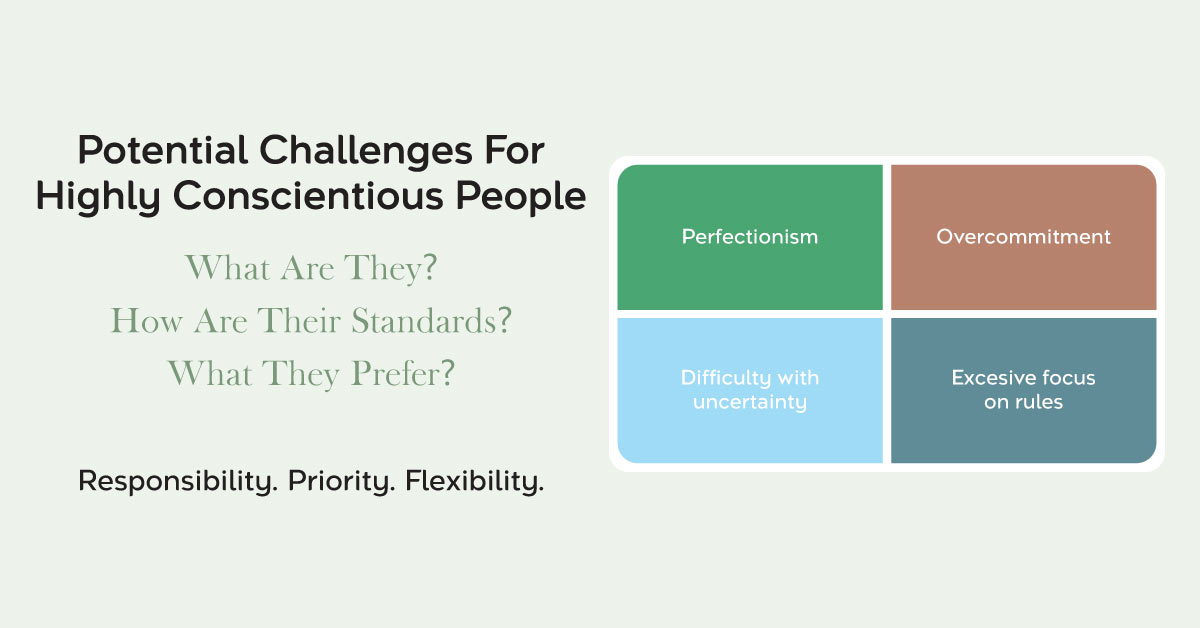
Perfectionism
Some highly conscientious people may set extremely high standards for themselves.
This can encourage quality work, but excessive perfectionism may make it difficult to complete tasks efficiently or accept mistakes.
Difficulty With Uncertainty
People who prefer planning and structure may find constantly changing environments uncomfortable.
Learning to adapt when plans change can be an important professional skill.
Overcommitment
A strong sense of responsibility can sometimes lead people to take on too many tasks.
Learning to prioritise and establish boundaries can help maintain sustainable workloads.
Excessive Focus on Rules
Structure can be useful, but some situations require flexibility and independent judgment.
Being able to adapt procedures when circumstances change can be valuable.
How to Choose a Career If You Are Highly Conscientious
If you recognise yourself as highly conscientious, consider the following questions.
Do You Enjoy Structure?
Think about whether you prefer:
- Clear processes
- Defined responsibilities
- Predictable schedules
- Detailed plans
- Measurable goals
If so, structured work environments may be worth exploring.
Do You Enjoy Responsibility?
Consider whether you enjoy being responsible for:
- Projects
- People
- Processes
- Budgets
- Deadlines
- Outcomes
If responsibility motivates you, careers involving coordination or management may be worth investigating.
Do You Enjoy Detail-Oriented Work?
Think about how you feel about tasks that require:
- Accuracy
- Documentation
- Checking information
- Research
- Organisation
- Quality control
If you enjoy this type of work, detail-oriented professions may be a good area to explore.
What Are Your Interests?
Personality alone should never determine your career.
A highly conscientious person who loves technology may be interested in engineering or software development.
Someone who enjoys helping people may prefer healthcare or education.
Someone interested in business may prefer finance, operations, or management.
Your interests can help determine which career areas are worth exploring.
What Are Your Other Strengths?
Consider your abilities in areas such as:
- Mathematics
- Communication
- Technology
- Writing
- Leadership
- Problem-solving
- Research
- Creativity
The best career fit may come from the combination of your personality and other characteristics.
Can a Career Aptitude Test Help?
A career aptitude test can provide another perspective when exploring career options.
Instead of focusing exclusively on conscientiousness, a broader career assessment may consider several characteristics, such as:
- Interests
- Personality
- Strengths
- Abilities
- Work preferences
This can help you identify career areas that may align with several aspects of your profile.
For example, two highly conscientious people could receive very different career recommendations because their interests and abilities are different.
One might enjoy analytical work and explore finance or engineering.
Another might enjoy working with people and explore healthcare, education, or management.
The purpose of a career assessment is therefore not to place you into a single category, but to help you explore possibilities.
How Personality Insights Can Support Career Decisions
Personality insights can be particularly useful when comparing different career environments.
For example, you may discover that you strongly prefer:
- Clear expectations
- Long-term planning
- Independent responsibility
- Detailed work
- Consistent processes
You can then look for careers and workplaces that offer some of these characteristics.
At the same time, it is important to consider whether the actual responsibilities of a career match your interests and abilities.
A job title alone does not tell you what your everyday work will look like.
Research the role, speak with professionals, review job descriptions, and consider the education or training required before making a decision.
Conclusion
Highly conscientious people may bring valuable qualities to the workplace, including organisation, persistence, responsibility, planning, and attention to detail.
These characteristics may make certain career environments particularly appealing, including fields such as finance, project management, engineering, healthcare, law, operations, research, and quality assurance.
However, conscientiousness does not determine the right career.
Your interests, abilities, values, personality, preferred work environment, education, and career goals all contribute to career fit.
Rather than asking, “What career should a conscientious person choose?”, a better question may be:
“Which career allows me to use my strengths while doing work I genuinely value and enjoy?”
A career aptitude test can provide another perspective by helping you explore how different characteristics may connect with potential career paths.
Ready to explore careers that match your strengths, interests, and abilities? Take our Career Aptitude Test and discover potential career paths.

