

Does IQ Affect Career Success?
Introduction
Intelligence is often associated with academic achievement and professional success. This leads to an important question: does IQ affect career success?
IQ tests are designed to measure certain cognitive abilities, such as reasoning, problem-solving, verbal comprehension, and working with information. These abilities can be relevant to many types of work.
However, IQ is only one factor among many that can influence career development and professional performance.
Motivation, personality, communication skills, emotional awareness, education, experience, interests, work habits, opportunities, and the work environment can all play important roles.
This means that having a high IQ does not automatically guarantee career success, just as a particular IQ score does not determine which career someone should pursue.
In this guide, we'll explore the relationship between IQ and career success, what IQ tests actually measure, and why cognitive ability should be considered alongside other characteristics when exploring career options.
What Is IQ?
IQ stands for intelligence quotient.
An IQ assessment is designed to evaluate certain cognitive abilities using standardised tasks. Depending on the assessment, these tasks may involve areas such as:
- Logical reasoning
- Verbal reasoning
- Numerical reasoning
- Pattern recognition
- Working with information
- Problem-solving
- Processing information
IQ tests are therefore focused primarily on cognitive abilities.
They are not designed to measure every characteristic that contributes to someone's professional performance or career satisfaction.
For example, an IQ test does not provide a complete picture of someone's motivation, creativity, interpersonal skills, personality, interests, or work preferences.
What Does an IQ Test Measure?
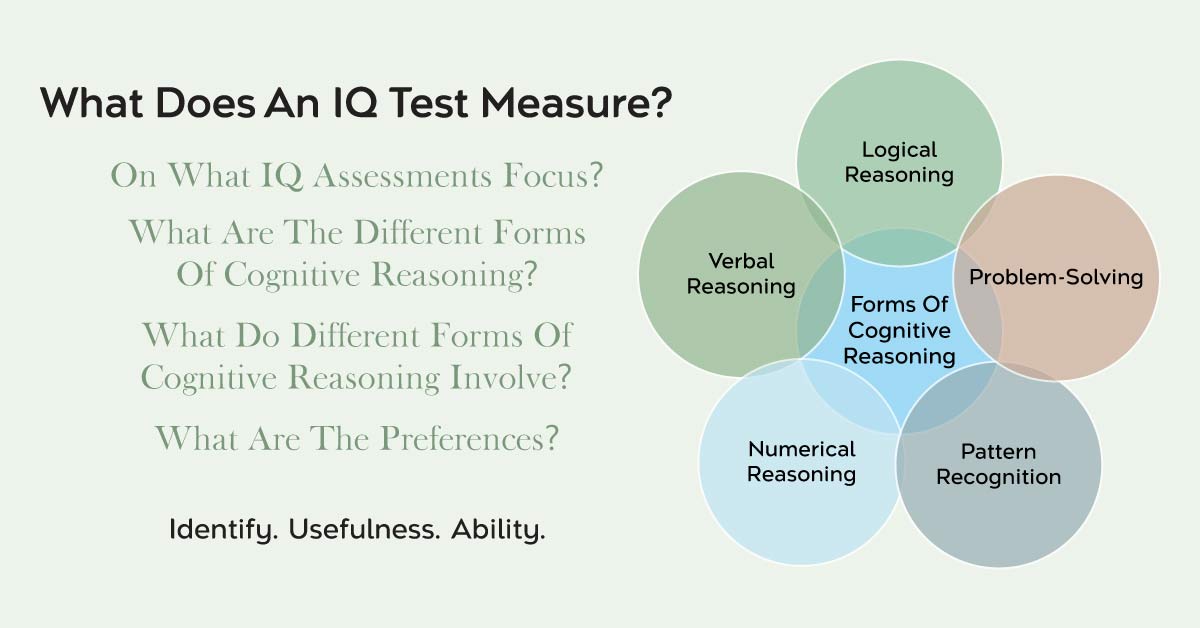
Different IQ assessments use different methods, but many focus on several forms of cognitive reasoning.
Logical Reasoning
Logical reasoning involves identifying relationships, patterns, rules, and conclusions.
This type of reasoning can be useful when analysing problems or determining how different pieces of information relate to one another.
Verbal Reasoning
Verbal reasoning involves understanding and working with language and verbal information.
It may be relevant to tasks involving:
- Reading comprehension
- Verbal analysis
- Communication
- Understanding instructions
- Evaluating written information
Numerical Reasoning
Numerical reasoning involves working with numbers, quantities, and mathematical relationships.
It can be useful in occupations involving financial information, data, analysis, engineering, science, or other quantitative tasks.
Pattern Recognition
Pattern recognition involves identifying relationships or structures within information.
This type of ability can be relevant to analytical and problem-solving activities.
Problem-Solving
Many cognitive assessments involve tasks that require individuals to analyse information and determine an appropriate solution.
Problem-solving is relevant across many professional environments, although real-world problem-solving also depends on knowledge, experience, judgement, and context.
Does IQ Affect Career Success?
IQ can be relevant to career success in some circumstances, particularly when a job involves substantial cognitive demands.
People with stronger cognitive abilities may find certain complex learning or reasoning tasks easier.
However, career success is much broader than cognitive ability.
Professional outcomes can also depend on:
- Knowledge
- Education
- Experience
- Motivation
- Personality
- Communication
- Teamwork
- Leadership
- Persistence
- Organisation
- Adaptability
- Career opportunities
Two people with similar cognitive abilities can therefore have very different career outcomes.
Likewise, people with different cognitive profiles can succeed in the same profession by developing different strengths and skills.
Why IQ Does Not Determine Career Success
Career success is a complex outcome.
Consider someone with strong reasoning abilities who has little interest in their chosen profession.
They may be capable of performing the work but become disengaged over time.
Now consider someone with average cognitive abilities who is highly motivated, develops strong professional skills, communicates effectively, builds good relationships, and consistently improves their knowledge.
Their career may develop very differently.
This illustrates an important distinction:
Being capable of doing something is not the same as being motivated to do it.
Career development involves both ability and many other personal and environmental factors.
IQ and Job Performance
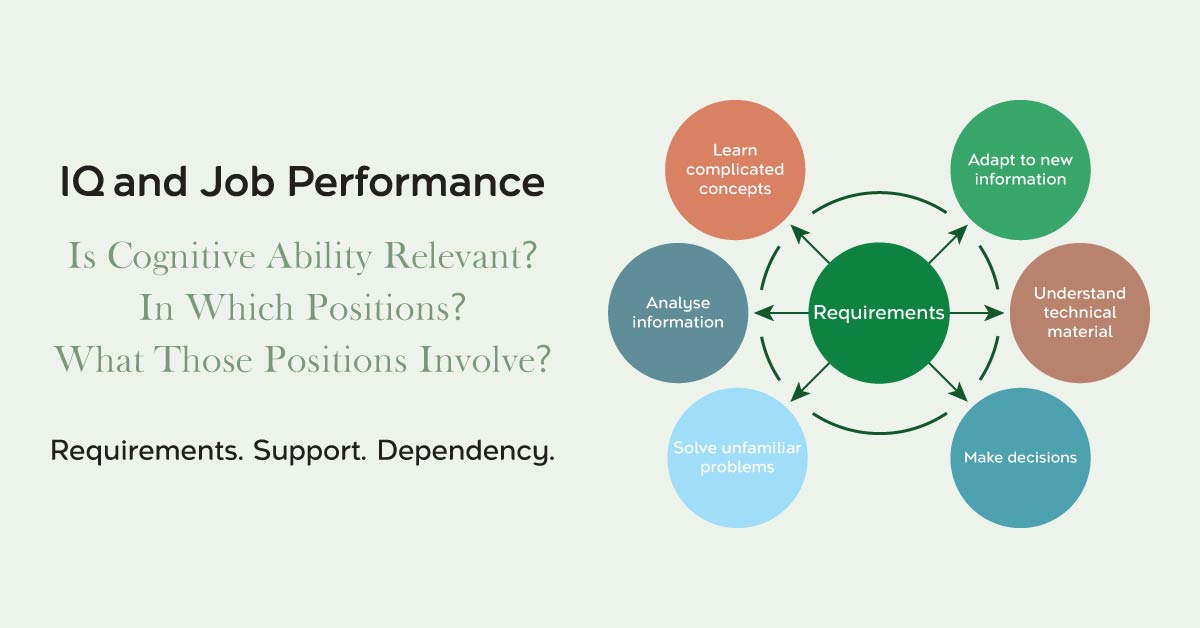
Cognitive ability can be relevant to job performance, particularly in positions involving learning, reasoning, decision-making, and complex information.
For example, some roles require employees to:
- Learn complicated concepts
- Analyse information
- Solve unfamiliar problems
- Make decisions
- Understand technical material
- Adapt to new information
Cognitive abilities can support these activities.
However, job performance also depends on whether a person has the required knowledge, training, experience, motivation, and professional skills.
Someone may have strong reasoning ability but still need extensive training before performing effectively in a specialised profession.
IQ and Different Careers
There is no single IQ level that guarantees success in a particular career.
Different occupations require different combinations of abilities and skills.
For example:
Technology and Engineering
These fields may involve:
- Analytical thinking
- Logical reasoning
- Mathematical concepts
- Problem-solving
- Technical knowledge
Healthcare
Healthcare careers can require:
- Scientific knowledge
- Attention to detail
- Decision-making
- Communication
- Emotional awareness
- Practical skills
Business and Management
Management roles can involve:
- Problem-solving
- Communication
- Decision-making
- Organisation
- Leadership
- Relationship management
Creative Careers
Creative careers may involve:
- Original thinking
- Communication
- Creativity
- Adaptability
- Technical skills
Cognitive ability can contribute to many of these activities, but it is not the only relevant characteristic.
Can a High IQ Make Some Careers Easier?
In some situations, stronger cognitive abilities may make certain types of learning or reasoning easier.
For example, someone may find complex analytical material easier to understand or quickly identify patterns in unfamiliar information.
However, this does not mean that a high IQ automatically makes a person successful in a particular career.
A demanding profession may require years of education, practical experience, discipline, communication skills, and professional judgement.
Cognitive ability can support learning, but it does not replace the need to develop expertise.
Can Someone With an Average IQ Have a Successful Career?
Absolutely.
Career success does not require exceptional performance on an IQ test.
Many professional skills are developed through:
- Education
- Training
- Practice
- Experience
- Feedback
- Mentoring
- Persistence
A person can build substantial expertise over time.
In addition, different careers reward different combinations of characteristics.
Someone may have particular strengths in communication, organisation, creativity, interpersonal relationships, practical work, leadership, or other areas.
These strengths can be highly valuable even though they are not captured by a traditional IQ score.
IQ vs Personality
An IQ test and a personality test measure different types of characteristics.
An IQ test primarily focuses on cognitive abilities such as reasoning and problem-solving.
A personality test explores characteristics related to behavioural tendencies, preferences, and patterns of interaction.
For example, personality information may help you consider whether you prefer:
- Independent or collaborative work
- Structure or flexibility
- Routine or variety
- Social interaction or focused individual work
Cognitive ability and personality can therefore provide different perspectives.
Neither one provides a complete picture of career fit.
IQ vs Career Aptitude Tests
A career aptitude test can have a broader career-exploration focus.
Depending on the assessment, it may consider multiple factors such as:
- Interests
- Personality
- Strengths
- Abilities
- Work preferences
An IQ test, by comparison, focuses primarily on cognitive abilities.
This is why an IQ test can provide useful information about certain cognitive strengths without necessarily telling you which career you will enjoy or find satisfying.
For a deeper explanation of what career aptitude assessments evaluate, see What Does a Career Aptitude Test Measure?
The Role of Personality in Career Success
Cognitive ability is only one part of professional development.
Personality characteristics can also influence how people approach their work.
For example, someone who is highly conscientious may naturally focus on organisation and completing responsibilities.
Someone who is highly open to experience may enjoy learning, experimentation, and new ideas.
Someone who enjoys social interaction may prefer collaborative or people-focused environments.
Understanding these characteristics can help individuals consider what types of work environments may suit their preferences.
For more information, see How Personality Influences Career Success.
Other Factors That Can Influence Career Success
Motivation
Motivation can influence how consistently someone works toward professional goals.
A person who is genuinely interested in their work may be more likely to invest time and effort in developing their abilities.
Education
Education can provide foundational knowledge and qualifications required for many professions.
Experience
Practical experience allows people to apply knowledge, develop judgement, and learn how to handle real-world situations.
Communication
The ability to explain ideas, listen, collaborate, and communicate effectively can be important across many careers.
Emotional Awareness
Understanding your own reactions and responding appropriately to others can support teamwork, leadership, customer relationships, and conflict management.
Persistence
Professional development often involves setbacks, mistakes, and periods of slow progress.
Persistence can help people continue developing despite these challenges.
Adaptability
Industries and workplaces change over time.
The ability to learn new processes and adjust to changing circumstances can be useful throughout a career.
Should You Take an IQ Test for Career Planning?
An IQ test can provide information about certain cognitive abilities.
It may help you better understand areas such as reasoning, problem-solving, or pattern recognition.
However, taking an IQ test alone is unlikely to provide a complete answer to the question:
“Which career is right for me?”
For career exploration, it can be more useful to consider cognitive ability alongside other factors.
These might include:
- Interests
- Personality
- Strengths
- Skills
- Work preferences
- Values
- Career goals
A broader assessment approach can provide a more complete starting point for career exploration.
How a Career Aptitude Test Can Help
A career aptitude test can help you explore potential career directions by considering multiple aspects of your profile.
Depending on the assessment, it may help you understand:
- What interests you
- Where your strengths may lie
- What types of work you may prefer
- Which environments may suit your preferences
- Which career areas you may want to investigate further
The purpose is not to determine your future.
Instead, assessment results can give you ideas to research and compare.
You can then combine those insights with real-world information about education requirements, job responsibilities, salaries, working conditions, and career opportunities.
How to Use IQ Results Responsibly
If you take an IQ test, avoid interpreting your score as a complete measure of your potential.
Instead, consider it as information about certain cognitive abilities assessed by that particular test.
You should also avoid assuming:
- A high score guarantees success.
- A lower score means you cannot succeed.
- Your score determines your ideal career.
- Cognitive ability cannot change or develop through learning and experience.
- One assessment captures every aspect of intelligence.
A test result is most useful when considered within the context of your broader abilities and goals.
Conclusion
IQ can be relevant to career development, particularly when a profession involves learning, reasoning, analysing information, and solving complex problems.
But IQ does not determine career success.
Professional outcomes are influenced by many factors, including education, experience, motivation, personality, communication, persistence, adaptability, opportunities, and workplace conditions.
An IQ test can provide one perspective on cognitive abilities. A personality test can provide insights into behavioural tendencies and preferences. A career aptitude test can offer a broader framework for exploring potential career directions.
The most useful approach is therefore not to ask whether your IQ is “high enough” for a career.
Instead, consider the bigger picture:
What are you interested in? What are your strengths? How do you prefer to work? What skills can you develop? And which career options fit your goals and circumstances?
Ready to explore careers that match more than just cognitive ability? Take our Career Aptitude Test and discover potential career paths based on your broader profile.

