

IQ Tests in Recruitment Explained
Introduction
IQ tests are sometimes used as part of the recruitment process to provide employers with information about certain cognitive abilities.
These assessments may evaluate areas such as logical reasoning, numerical reasoning, verbal reasoning, problem-solving, and pattern recognition.
For employers, this information can be relevant when a position involves learning new information, analysing complex problems, or working with unfamiliar situations.
However, an IQ test does not provide a complete picture of a candidate's professional potential. Personality, experience, education, motivation, communication skills, technical knowledge, and other characteristics can also influence workplace performance.
In this guide, we'll explain IQ tests in recruitment, what they measure, why employers may use them, how they differ from other assessments, and what job seekers should know before taking one.
What Is an IQ Test?
An IQ test is a structured assessment designed to evaluate certain cognitive abilities.
Depending on the assessment, it may include tasks involving:
- Logical reasoning
- Verbal reasoning
- Numerical reasoning
- Pattern recognition
- Problem-solving
- Working with information
Some assessments produce an overall score, while others provide scores across different cognitive areas.
The exact format and interpretation depend on the test being used.
An IQ test should therefore be understood as a measure of certain cognitive abilities rather than a complete measurement of everything that contributes to workplace performance.
Why Do Employers Use IQ Tests?
Employers may use cognitive assessments during recruitment for several reasons.
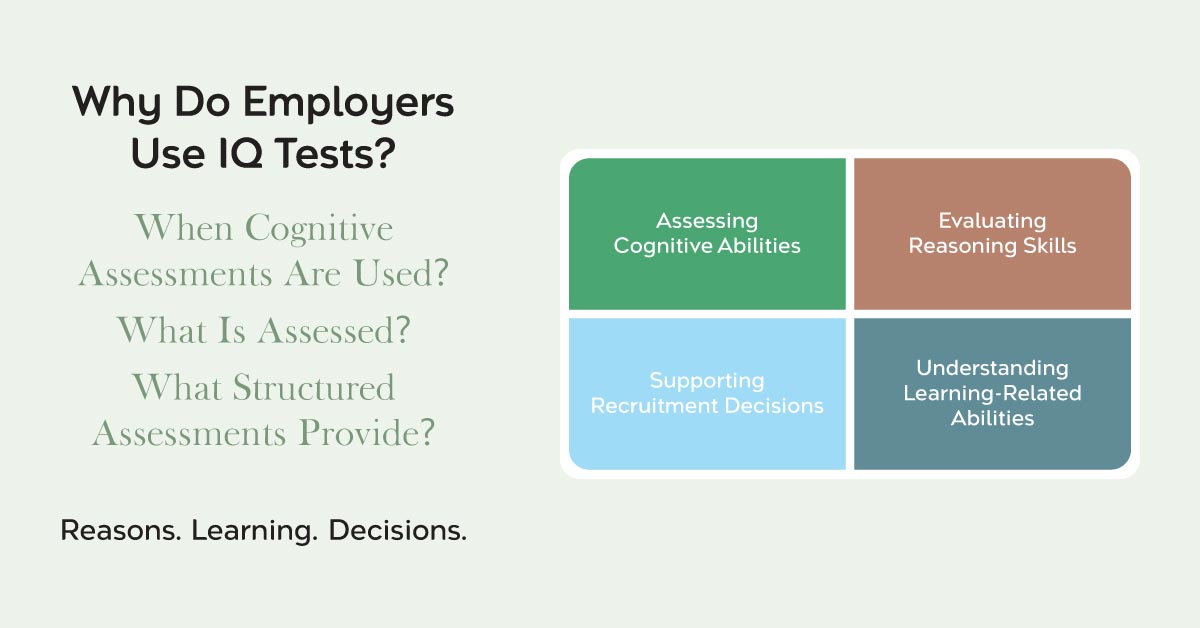
Assessing Cognitive Abilities
Some jobs require employees to analyse information, solve problems, learn new concepts, or make decisions.
An assessment can provide information about certain abilities that may be relevant to these tasks.
Supporting Recruitment Decisions
When employers are evaluating multiple candidates, structured assessments can provide an additional source of information alongside applications, interviews, qualifications, and experience.
Evaluating Reasoning Skills
Certain positions involve substantial analytical work.
An assessment may examine abilities such as:
- Identifying patterns
- Evaluating information
- Drawing logical conclusions
- Solving unfamiliar problems
Understanding Learning-Related Abilities
Some roles require employees to learn new systems, processes, technologies, or technical information.
Cognitive assessments may provide information about certain abilities involved in processing and reasoning with new information.
However, actual learning and professional development also depend on education, motivation, training, experience, and the environment in which learning takes place.
What Do IQ Tests Measure in Recruitment?
The content of an IQ or cognitive assessment varies, but several areas are common.
Logical Reasoning
Logical reasoning involves identifying relationships, patterns, rules, and conclusions.
It can be relevant to jobs involving structured analysis and problem-solving.
For examples of careers where logical reasoning can be useful, see Jobs That Require Strong Logical Reasoning.
Numerical Reasoning
Numerical reasoning involves understanding and working with numbers and quantitative information.
It can be useful in roles involving:
- Finance
- Accounting
- Data
- Engineering
- Business analysis
Verbal Reasoning
Verbal reasoning involves understanding and analysing language-based information.
It may be relevant to roles requiring employees to interpret written information, evaluate arguments, or work with complex documentation.
Abstract Reasoning
Abstract reasoning involves identifying relationships and patterns without relying entirely on familiar subject matter.
Tasks may involve shapes, sequences, diagrams, or other forms of abstract information.
Problem-Solving
Problem-solving tasks may require candidates to analyse information and determine an appropriate solution.
These tasks can provide information about certain aspects of analytical thinking.
Are IQ Tests the Same as Cognitive Ability Tests?
The terms can sometimes be used interchangeably in everyday discussions, but they do not always refer to exactly the same type of assessment.
IQ tests are generally designed to assess certain cognitive abilities and may produce an overall intelligence score.
Cognitive ability tests used in recruitment may focus on specific abilities relevant to workplace tasks.
The design, scoring system, purpose, and interpretation can therefore differ between assessments.
For more information about why employers use these assessments, see Why Employers Use Cognitive Ability Tests.
IQ Tests vs Personality Tests in Recruitment
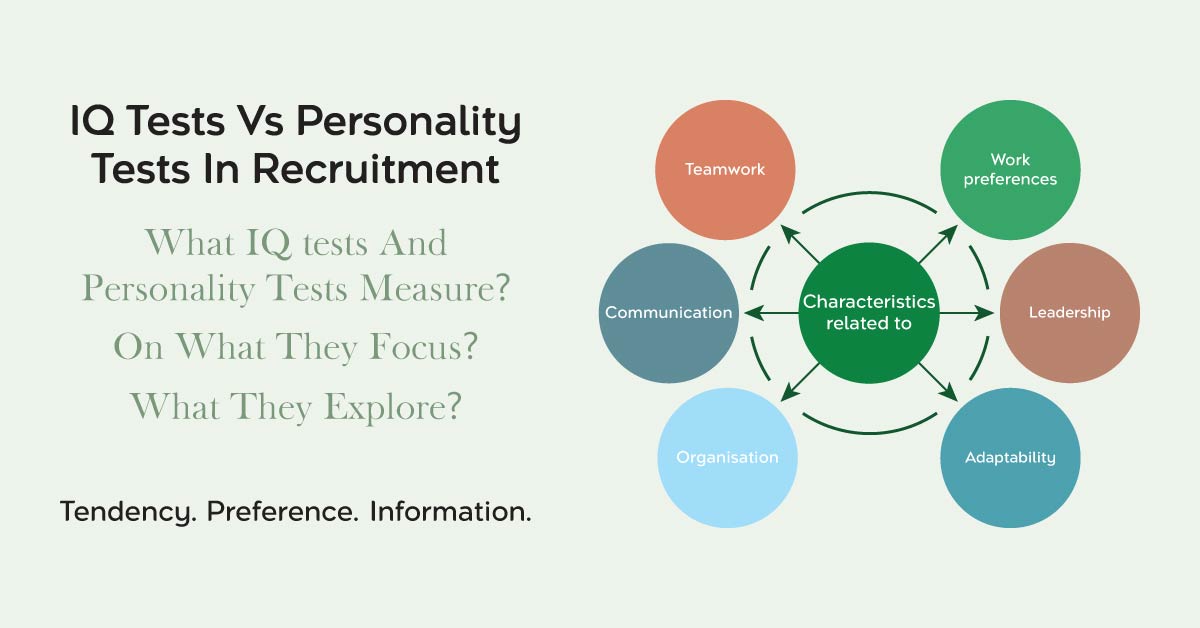
IQ tests and personality tests measure different types of characteristics.
An IQ test primarily focuses on certain cognitive abilities.
A personality test explores behavioural tendencies and preferences.
For example, personality assessments may provide information about characteristics related to:
- Teamwork
- Communication
- Organisation
- Adaptability
- Leadership
- Work preferences
These characteristics can provide a different perspective from cognitive ability.
A candidate may perform strongly on cognitive tasks while having a very different working style from another candidate with a similar cognitive profile.
Using different assessment methods can therefore provide employers with information about different aspects of a candidate.
IQ Tests vs Career Aptitude Tests
An IQ test and a career aptitude test generally have different purposes.
An IQ test primarily focuses on certain cognitive abilities.
A career aptitude test is typically designed for career exploration and may consider a broader combination of factors, such as:
- Interests
- Personality
- Strengths
- Abilities
- Work preferences
This means that an IQ test may help you understand certain cognitive strengths, while a career aptitude test can help you explore potential career directions based on a broader profile.
For a more detailed comparison, see Career Aptitude Tests vs IQ Tests.
What Types of Jobs May Use IQ or Cognitive Tests?
The use of cognitive assessments varies considerably between employers and industries.
They may be relevant to positions involving substantial:
- Analysis
- Problem-solving
- Information processing
- Technical learning
- Decision-making
- Numerical work
Examples may include roles in:
- Technology
- Engineering
- Finance
- Data analysis
- Consulting
- Research
- Business analysis
- Certain administrative positions
The specific assessment used should ideally relate to the requirements of the position.
Are IQ Tests Common in Recruitment?
Recruitment practices vary by employer, industry, location, and role.
Some organisations use cognitive ability assessments as part of their selection process, while others may rely more heavily on interviews, qualifications, technical assessments, work samples, or previous experience.
There is therefore no universal recruitment process.
A candidate should always check the information provided by the employer to understand what assessments will be used and how they fit into the overall hiring process.
When Are IQ Tests Used During Recruitment?
The timing can vary.
An employer may use a cognitive assessment:
- Early in the application process
- After an initial screening
- Before an interview
- Between interview stages
- As part of an assessment centre
- Alongside other recruitment assessments
For example, an organisation receiving a large number of applications may use an assessment early in the process.
Another employer may use testing later, after candidates have already completed an interview.
What Should You Expect During an IQ Test?
The exact experience depends on the assessment.
You may encounter questions involving:
- Number sequences
- Verbal relationships
- Logical patterns
- Shapes
- Visual sequences
- Numerical problems
- Problem-solving tasks
Some tests are timed.
Others may provide different testing conditions.
Before beginning, candidates should carefully read the instructions and understand how the assessment is structured.
How to Prepare for an IQ Test in Recruitment
Preparation can help you become more familiar with common question formats.
You can practise:
Logical Reasoning
Work through pattern, sequence, and deduction questions.
Numerical Reasoning
Practise interpreting numbers, percentages, ratios, and numerical relationships.
Verbal Reasoning
Practise understanding written information and identifying logical conclusions.
Time Management
If the assessment is timed, practise answering questions efficiently without spending too long on one problem.
Familiarity With Test Formats
Understanding how different question types work can make the assessment process less unfamiliar.
Preparation should focus on becoming comfortable with the format and improving your approach rather than attempting to predict the exact questions that will appear.
What If You Get a Low Score?
A single assessment result should not be interpreted as a complete measure of your professional potential.
Performance on a test can be influenced by factors such as:
- Test familiarity
- Time pressure
- Concentration
- Fatigue
- Anxiety
- Testing conditions
- Accessibility considerations
More importantly, professional performance involves much more than cognitive ability.
Education, experience, technical knowledge, communication, motivation, teamwork, personality, and many other factors can contribute to success at work.
Does a High IQ Guarantee a Job?
No.
A high IQ score does not guarantee that someone will be hired.
Recruitment decisions can consider many factors, including:
- Qualifications
- Experience
- Technical skills
- Interview performance
- Communication
- Personality
- Motivation
- Work samples
- Cognitive abilities
- Job-specific requirements
An employer may use an IQ or cognitive assessment as one part of a broader selection process.
Does a High IQ Mean You Will Perform Better at Work?
Not necessarily.
Cognitive ability can be relevant to certain aspects of job performance, particularly where work involves learning, reasoning, or complex information.
However, professional performance also depends on the person's knowledge, training, experience, motivation, working environment, and other characteristics.
Someone with strong cognitive abilities may still need considerable training to perform effectively in a specialised role.
Similarly, someone with less exceptional cognitive test results can develop substantial expertise through education, practice, and experience.
Are IQ Tests Enough for Recruitment?
An IQ test alone cannot provide a complete picture of a candidate.
A broader recruitment process may include:
- Application review
- Interviews
- Technical assessments
- Work samples
- Cognitive assessments
- Personality assessments
- Qualifications
- Reference checks
Each method can provide different information.
The most appropriate approach depends on the role and the employer's recruitment process.
Are IQ Tests Fair in Recruitment?
The fairness of an assessment depends on factors such as its design, relevance to the role, administration, scoring, accessibility, and how the results are interpreted.
Employers should consider whether an assessment is appropriate for the position and whether candidates are given consistent and suitable testing conditions.
Employment assessment practices are also subject to applicable laws and regulations, which vary by jurisdiction.
For candidates, it is important to remember that a test score should not automatically be interpreted as a complete measure of ability or potential.
IQ Tests and Career Choice
An IQ assessment can provide information about certain cognitive strengths.
However, knowing your cognitive profile does not necessarily tell you which career you will enjoy.
For example, someone may demonstrate strong logical reasoning but prefer a highly social working environment.
Another person may enjoy analytical work but dislike highly structured environments.
Career choice involves considering multiple factors.
These can include:
- Interests
- Personality
- Strengths
- Abilities
- Work preferences
- Values
- Goals
- Education
- Career opportunities
A broader career assessment can therefore provide additional information when exploring potential career directions.
Should You Take an IQ Test Before Choosing a Career?
You can take an IQ test to learn more about certain cognitive abilities, but it should not be used as the sole basis for choosing a career.
Instead, consider cognitive ability alongside your interests, personality, strengths, and preferred working environment.
A career aptitude test can help you explore these broader factors and identify career areas worth researching further.
The goal is not to find a single career that a test says you must pursue.
The goal is to gather useful information that can support better-informed career decisions.
Conclusion
IQ tests in recruitment can provide employers with information about certain cognitive abilities, including reasoning, problem-solving, and working with information.
These abilities can be relevant to many jobs, particularly positions involving complex learning, analysis, and decision-making.
However, an IQ test is only one source of information.
A test score does not capture everything that can contribute to workplace performance or career success. Experience, education, technical skills, motivation, personality, communication, teamwork, and workplace conditions can all matter.
For employers, cognitive assessments can be one component of a broader recruitment process.
For individuals, IQ results can provide insights into certain cognitive strengths, but they should not be treated as a definitive guide to career choice.
If you're exploring your own career direction, consider your cognitive abilities alongside your interests, personality, strengths, and work preferences.
Ready to explore careers that match your broader profile? Take our Career Aptitude Test and discover potential career paths worth exploring.

