

Jobs That Require Strong Logical Reasoning
Published on: September 24, 2026
By : Teddy Bridges
Jobs That Require Strong Logical Reasoning
Introduction
Logical reasoning is an important ability in many areas of work.
Some careers require professionals to analyse information, identify patterns, evaluate evidence, solve complex problems, and make decisions based on available information.
These abilities can be particularly useful in fields such as technology, engineering, finance, law, science, data analysis, and certain business roles.
However, strong logical reasoning does not automatically determine career success. Most professions require a combination of cognitive abilities, technical knowledge, communication skills, experience, motivation, and other personal characteristics.
If you enjoy analysing problems, identifying patterns, and finding structured solutions, exploring careers that use logical reasoning may help you identify options that match some of your natural strengths.
In this guide, we'll explore jobs that require strong logical reasoning, what logical reasoning involves, and how you can use your abilities when exploring potential career paths.
What Is Logical Reasoning?
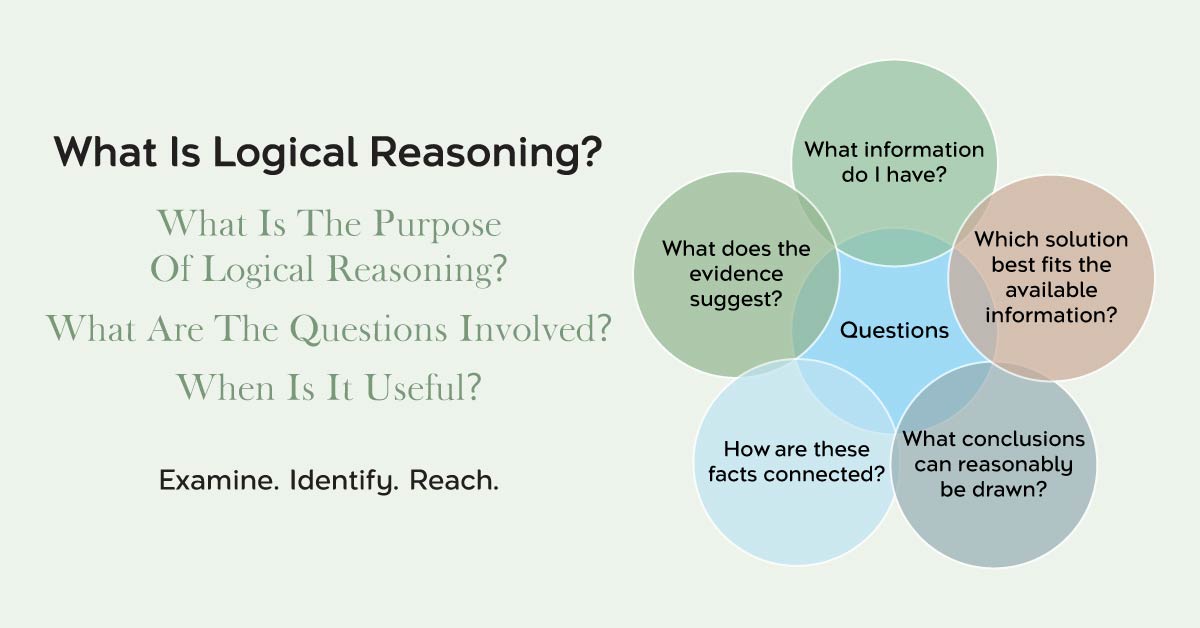
Logical reasoning is the ability to examine information, identify relationships, evaluate possibilities, and reach conclusions using a structured thought process.
It can involve questions such as:
- What information do I have?
- What does the evidence suggest?
- How are these facts connected?
- What conclusions can reasonably be drawn?
- Which solution best fits the available information?
Logical reasoning can be useful when dealing with both simple and highly complex problems.
It is also important to distinguish logical reasoning from general knowledge.
Someone may know a great deal about a particular subject without necessarily being strong at every type of reasoning task.
Similarly, someone with strong reasoning abilities may still need education and experience to apply those abilities effectively in a specialised profession.
What Does a Logical Reasoning Job Involve?
Jobs that rely heavily on logical reasoning often involve one or more of the following activities:
- Analysing information
- Identifying patterns
- Solving problems
- Comparing alternatives
- Evaluating evidence
- Making decisions
- Testing ideas
- Understanding systems
- Finding errors
- Developing solutions
The exact type of reasoning required varies significantly between careers.
For example, a software developer may use logical reasoning to identify why a program is not working.
An accountant may use it to examine financial information.
A lawyer may use it to evaluate evidence and construct an argument.
An engineer may use it to determine how a system should function.
Jobs That Require Strong Logical Reasoning
1. Software Developer
Software development often requires structured problem-solving and logical thinking.
Developers may need to:
- Break complex problems into smaller components
- Identify errors in code
- Understand how systems interact
- Develop step-by-step solutions
- Test different approaches
- Analyse unexpected results
Logical reasoning is particularly useful when debugging or designing software systems.
However, successful software development also requires programming knowledge, technical skills, creativity, attention to detail, and continuous learning.
2. Data Analyst
Data analysts work with information to identify patterns, trends, and relationships.
Their responsibilities may include:
- Cleaning data
- Analysing datasets
- Identifying trends
- Comparing results
- Creating reports
- Communicating findings
Logical reasoning can help analysts determine whether conclusions are supported by the available data.
Strong analytical skills are also important because data can be incomplete, inconsistent, or misleading without appropriate interpretation.
3. Engineer
Engineering involves applying scientific and mathematical principles to practical problems.
Different engineering fields can involve:
- Designing systems
- Testing solutions
- Analysing failures
- Calculating requirements
- Evaluating risks
- Improving performance
Logical reasoning can help engineers understand complex relationships and determine how different components interact.
Engineering also requires substantial technical knowledge and specialised education.
4. Accountant
Accounting involves working systematically with financial information.
Accountants may need to:
- Analyse financial records
- Identify discrepancies
- Apply accounting principles
- Calculate financial information
- Evaluate transactions
- Prepare reports
Logical reasoning and attention to detail can support accurate analysis.
However, accounting also requires technical knowledge, professional standards, communication skills, and familiarity with relevant regulations.
5. Financial Analyst
Financial analysts evaluate financial and business information to support decision-making.
Their work may involve:
- Analysing financial statements
- Comparing investment opportunities
- Evaluating business performance
- Examining market information
- Building financial models
- Identifying potential risks
Logical reasoning can help professionals evaluate relationships between different pieces of financial information.
Other important characteristics include numerical ability, financial knowledge, research skills, and attention to detail.
6. Actuary
Actuaries use mathematics, statistics, and analytical methods to evaluate financial risk and uncertainty.
They may work in areas such as:
- Insurance
- Pensions
- Investments
- Risk management
Actuarial work can require advanced quantitative reasoning and the ability to work with complex models.
It also involves specialised education and professional training.
7. Scientist
Scientific work often involves asking questions, developing hypotheses, analysing evidence, and interpreting results.
Scientists may need to:
- Design experiments
- Analyse data
- Test hypotheses
- Evaluate evidence
- Identify patterns
- Draw conclusions
Logical reasoning is important because scientific conclusions need to be supported by evidence.
Scientific careers also require subject-specific knowledge, research skills, and often advanced education.
8. Lawyer
Lawyers frequently analyse information and construct arguments based on evidence, legal rules, and precedent.
Logical reasoning can be useful when:
- Examining evidence
- Identifying inconsistencies
- Interpreting information
- Comparing arguments
- Building legal reasoning
- Evaluating possible outcomes
Legal careers also require extensive knowledge of the law, communication skills, research abilities, and strong attention to detail.
9. Cybersecurity Analyst
Cybersecurity professionals work to identify and respond to potential security threats.
Their work can involve:
- Analysing unusual activity
- Identifying vulnerabilities
- Investigating incidents
- Understanding system behaviour
- Evaluating security risks
- Developing protective measures
Logical reasoning can help professionals investigate how different events may be connected.
Cybersecurity also requires technical knowledge, continuous learning, and familiarity with evolving threats and technologies.
10. Economist
Economists analyse how individuals, organisations, and markets behave.
Their work may involve:
- Analysing economic data
- Building models
- Evaluating policies
- Studying market behaviour
- Interpreting statistical information
- Developing economic forecasts
Logical and analytical reasoning can support this type of work.
Economics careers can also require strong mathematical, statistical, research, and communication skills.
11. Operations Research Analyst
Operations research analysts use analytical methods to help organisations make decisions.
They may examine:
- Costs
- Resources
- Processes
- Scheduling
- Logistics
- Business performance
Their goal may be to identify ways of improving efficiency or solving complex organisational problems.
This type of work can involve substantial mathematical and analytical reasoning.
12. Management Consultant
Management consultants analyse business problems and develop recommendations for organisations.
Their work can involve:
- Collecting information
- Analysing business processes
- Identifying problems
- Comparing solutions
- Evaluating opportunities
- Presenting recommendations
Logical reasoning can help consultants structure complex problems and evaluate potential solutions.
Communication and interpersonal skills are equally important because recommendations need to be explained clearly to clients.
Other Careers Where Logical Reasoning Can Be Useful
Logical reasoning can also be valuable in many other professions, including:
- Statistician
- Economist
- Researcher
- Financial planner
- Business analyst
- Systems analyst
- Database administrator
- Information security specialist
- Quality assurance specialist
- Architect
- Pharmacist
- Auditor
- Supply chain analyst
- Market researcher
- Technical consultant
The amount and type of reasoning required varies considerably between positions.
Careers for People Who Enjoy Solving Problems
If you naturally enjoy solving problems, you may want to consider careers where analysing situations and finding solutions is a regular part of the work.
Examples include:
- Software development
- Engineering
- Data analysis
- Cybersecurity
- Research
- Consulting
- Finance
- Operations research
However, enjoying problem-solving is only one consideration.
You should also examine the subjects, working conditions, qualifications, responsibilities, and career progression associated with each profession.
Logical Reasoning and IQ Tests
Logical reasoning is one type of cognitive ability that may be assessed by certain IQ tests.
Depending on the assessment, an IQ test may examine abilities such as:
- Logical reasoning
- Pattern recognition
- Verbal reasoning
- Numerical reasoning
- Problem-solving
This can provide information about certain cognitive strengths.
However, an IQ score does not determine which career is right for you.
A career may require logical reasoning alongside many other abilities and characteristics.
For more information, see our article Does IQ Affect Career Success?
Logical Reasoning and Career Aptitude Tests
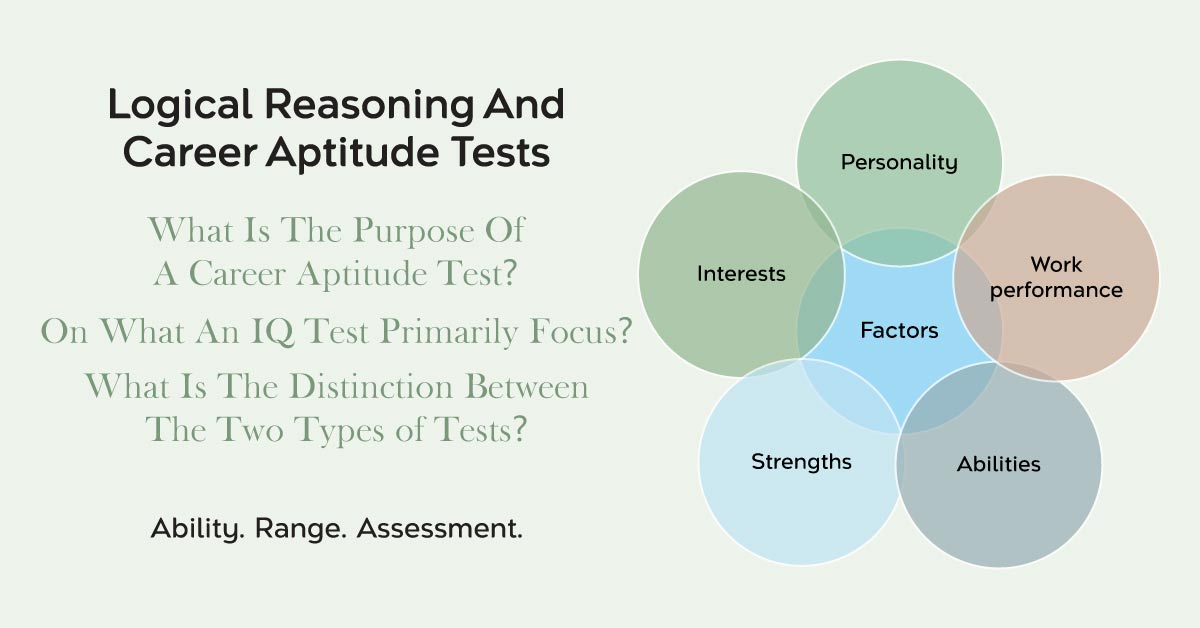
A career aptitude test has a different purpose from an IQ test.
An IQ test primarily focuses on cognitive abilities.
A career aptitude test may consider a broader range of factors related to career exploration, such as:
- Interests
- Personality
- Strengths
- Abilities
- Work preferencesInterests
- Personality
- Strengths
- Abilities
- Work preferences
This distinction is important.
You might have strong logical reasoning abilities but have little interest in careers that use them extensively.
Alternatively, you might enjoy analytical work but need to develop specific technical skills before pursuing a particular profession.
A broader assessment can therefore help you consider logical reasoning alongside other characteristics.
For a detailed explanation of what these assessments can evaluate, see What Does a Career Aptitude Test Measure?
Does Strong Logical Reasoning Mean You Should Choose a Technical Career?
Not necessarily.
Logical reasoning can be useful in technical careers, but it is not limited to them.
Law, finance, business, research, healthcare, management, and many other fields can involve analytical thinking.
The better question is:
Which careers allow you to use your reasoning abilities in ways that also interest you?
Career choice should consider both what you are capable of doing and what you actually want to do.
Logical Reasoning vs Creativity
Logical reasoning and creativity are sometimes treated as opposites.
In reality, many careers require both.
For example, a software developer may need logical reasoning to build a reliable system while also developing creative approaches to a problem.
An engineer may need analytical thinking to understand technical constraints while developing innovative solutions.
A business professional may analyse market information while developing a new strategy.
A scientist may use logical reasoning to evaluate evidence while developing new hypotheses.
Analytical and creative thinking can therefore complement each other.
Can Logical Reasoning Be Improved?
Logical reasoning can be developed and practised.
Activities that may encourage analytical thinking include:
- Solving logic problems
- Studying mathematics
- Learning programming
- Analysing data
- Playing strategy games
- Practising structured problem-solving
- Studying scientific methods
- Working through complex problems
Education and professional experience can also improve your ability to apply reasoning within a specific field.
For example, an experienced engineer may solve technical problems more effectively not only because of reasoning ability but also because of years of accumulated knowledge and experience.
How to Find a Career That Uses Your Strengths
If logical reasoning is one of your strengths, start by identifying the types of problems you actually enjoy solving.
Ask yourself:
- Do I enjoy working with numbers?
- Do I enjoy analysing data?
- Do I like technology?
- Do I enjoy understanding systems?
- Do I prefer practical or theoretical problems?
- Do I enjoy researching information?
- Do I prefer working independently or with a team?
- Do I enjoy structured or creative environments?
Your answers can help narrow down potential career directions.
You can then research the actual requirements of each career and determine which options fit your broader profile.
Consider Your Other Strengths
Logical reasoning should not be considered in isolation.
You may also have strengths in:
- Communication
- Creativity
- Leadership
- Organisation
- Empathy
- Attention to detail
- Collaboration
- Adaptability
The combination of strengths can be more informative than any single ability.
For example, someone with strong logical reasoning and communication skills might enjoy consulting or management.
Someone with analytical ability and creativity might prefer technology, design, research, or engineering.
Someone with reasoning ability and strong interpersonal skills might enjoy certain healthcare, business, or advisory roles.
Conclusion
Logical reasoning can be valuable in many careers, particularly those involving analysis, problem-solving, systems, evidence, numbers, or complex decision-making.
Software development, engineering, data analysis, finance, science, law, cybersecurity, and operations research are just some examples of fields where logical reasoning can play an important role.
However, logical reasoning alone does not determine career success.
Your interests, personality, communication skills, education, experience, motivation, values, and other strengths can all influence whether a career is a good fit for you.
Instead of looking for a career based on one ability, consider how your complete profile fits the requirements and environment of different professions.
A career aptitude test can provide a useful starting point by helping you explore your interests, strengths, personality, abilities, and work preferences.
Ready to explore careers that match your broader strengths? Take our Career Aptitude Test and discover potential career paths worth investigating.

