

Why Employers Use Cognitive Ability Tests
Published on: September 28, 2026
By : Ariadna Miles
Why Employers Use Cognitive Ability Tests
Introduction
Many employers use assessments during recruitment to gather additional information about candidates.
Among these assessments are cognitive ability tests, which are designed to evaluate certain mental abilities such as reasoning, problem-solving, numerical reasoning, verbal reasoning, and the ability to work with information.
Employers may use these tests because many jobs involve learning new information, analysing problems, making decisions, and adapting to changing situations.
However, cognitive ability is only one part of job performance. A test score does not provide a complete picture of someone's personality, motivation, communication skills, experience, or suitability for a particular workplace.
In this guide, we'll explain why employers use cognitive ability tests, what these assessments measure, how they can be used during recruitment, and why they should generally be considered alongside other sources of information.
What Is a Cognitive Ability Test?
A cognitive ability test is a structured assessment designed to measure specific mental abilities.
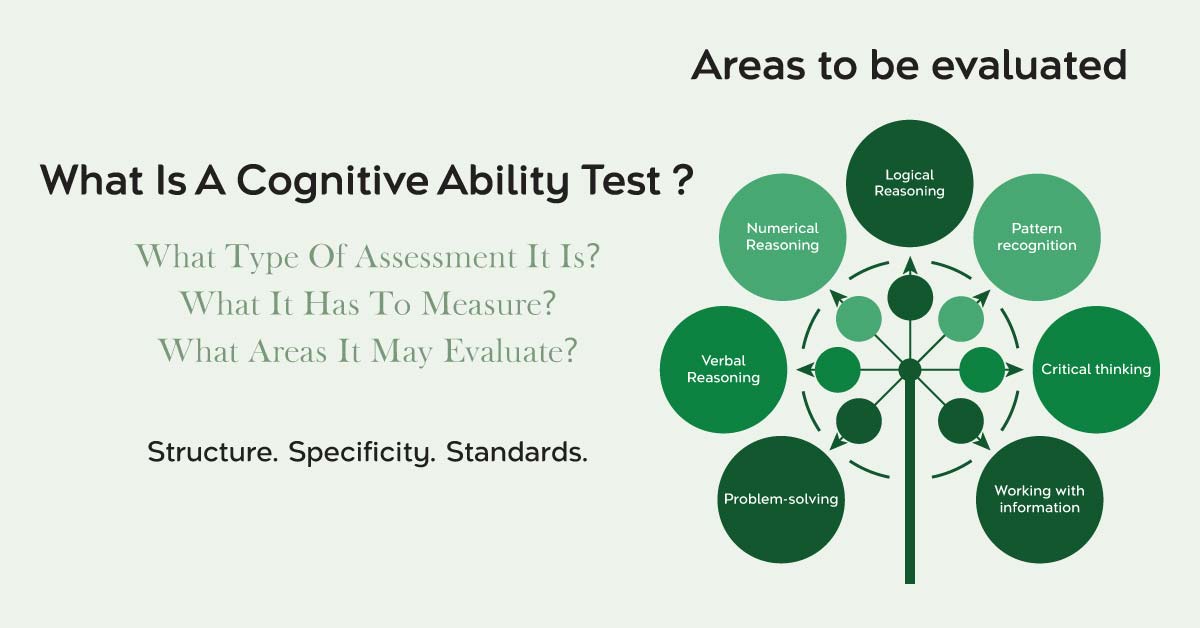
Depending on the assessment, it may evaluate areas such as:
- Logical reasoning
- Numerical reasoning
- Verbal reasoning
- Problem-solving
- Pattern recognition
- Working with information
- Critical thinking
These assessments are often completed under standardised conditions so that candidates respond to the same or comparable types of questions.
Cognitive ability tests are different from personality tests.
A cognitive assessment focuses primarily on certain mental abilities, while a personality assessment explores behavioural tendencies, preferences, and characteristics.
Why Do Employers Use Cognitive Ability Tests?
Employers may use cognitive ability tests for several reasons.
1. To Assess Reasoning Ability
Many jobs require employees to analyse information and reach reasonable conclusions.
A cognitive ability assessment can provide information about certain reasoning skills that may be relevant to the work.
For example, an employer may want to understand how a candidate approaches logical or numerical problems.
2. To Evaluate Problem-Solving
Problem-solving is part of many professional roles.
Employees may need to:
- Identify the source of a problem
- Evaluate available information
- Consider possible solutions
- Compare alternatives
- Make decisions
Cognitive assessments can include tasks designed to evaluate some of these abilities.
However, real-world problem-solving also depends on knowledge, experience, context, and judgement.
3. To Understand Learning Potential
Some jobs require employees to learn new processes, systems, concepts, or procedures.
Employers may therefore be interested in cognitive abilities associated with learning and processing information.
This can be particularly relevant when candidates are entering roles that involve unfamiliar or complex material.
4. To Compare Candidates Using a Structured Process
Recruitment decisions can involve many candidates.
A standardised assessment can give employers an additional source of comparable information.
Instead of relying entirely on interviews or application documents, employers can use different assessment methods to evaluate candidates from multiple perspectives.
This does not mean that a test score should replace professional judgement or other recruitment information.
5. To Identify Job-Relevant Abilities
Different jobs require different abilities.
For example, a position involving substantial numerical analysis may require strong numerical reasoning.
A technical role may involve logical and analytical problem-solving.
A position requiring extensive written communication may place greater emphasis on verbal abilities.
Cognitive assessments can therefore be selected based on the types of abilities relevant to a particular role.
What Do Cognitive Ability Tests Measure?
Cognitive assessments can measure several different abilities.
Logical Reasoning
Logical reasoning involves identifying relationships, patterns, rules, and conclusions.
It can be useful when a job involves structured analysis and problem-solving.
For more information about careers involving this type of ability, see Jobs That Require Strong Logical Reasoning.
Numerical Reasoning
Numerical reasoning involves understanding and working with numerical information.
It can be relevant to roles involving:
- Finance
- Accounting
- Data
- Business analysis
- Engineering
- Planning
Verbal Reasoning
Verbal reasoning involves understanding and analysing written or verbal information.
It can be useful in roles involving research, communication, documentation, analysis, or complex written material.
Abstract Reasoning
Abstract reasoning involves identifying patterns and relationships without relying heavily on familiar subject matter.
This type of reasoning may involve shapes, sequences, diagrams, or other abstract information.
Problem-Solving
Problem-solving assessments may require candidates to analyse information and identify an appropriate solution.
These tasks can provide information about certain aspects of analytical thinking.
Cognitive Ability Tests vs IQ Tests
Cognitive ability tests and IQ tests can overlap in the types of abilities they assess, but their purpose and context can differ.
An IQ test is generally designed to provide information about certain cognitive abilities and may produce an overall score.
A workplace cognitive ability test may instead focus on specific abilities that are relevant to recruitment or job performance.
The exact content depends on the assessment.
For a broader discussion of IQ and professional outcomes, see Does IQ Affect Career Success?
Cognitive Ability Tests vs Personality Tests
Cognitive ability and personality provide different types of information.
A cognitive ability test may examine how someone reasons, processes information, or solves certain types of problems.
A personality test may explore behavioural tendencies and preferences, such as how someone approaches teamwork, structure, social interaction, or change.
For employers, these can represent complementary sources of information.
A candidate may demonstrate strong reasoning ability while having a very different working style from another candidate with similar cognitive abilities.
Understanding both can provide a broader perspective, although neither type of assessment should be treated as a complete representation of a person.
What Are Employers Looking For?
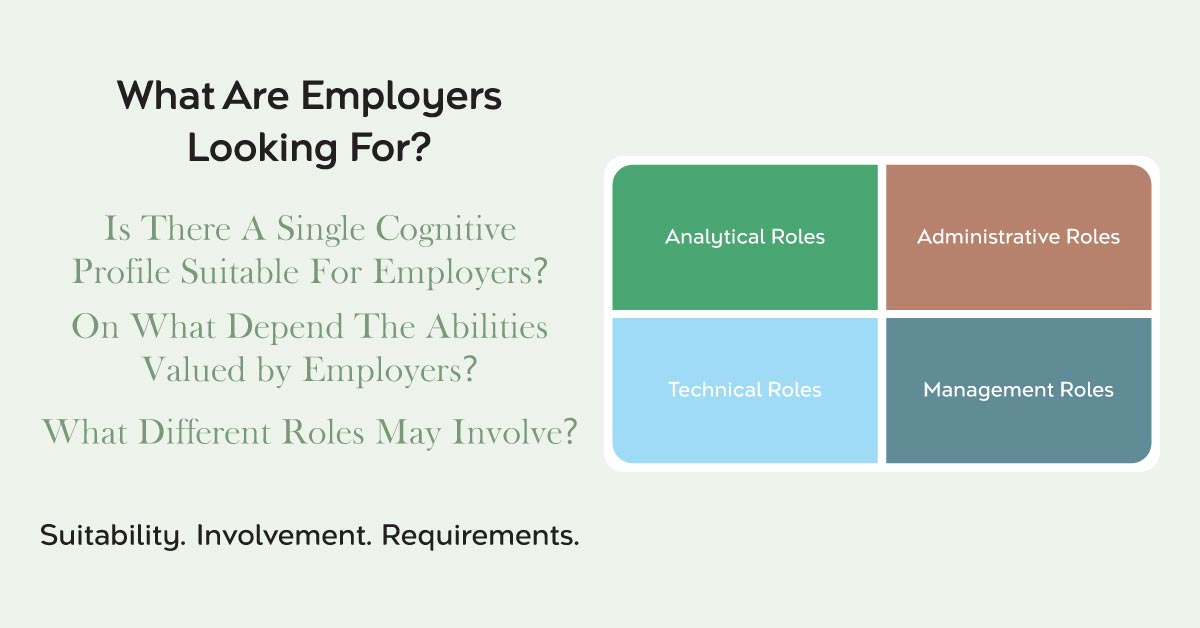
There is no single cognitive profile that makes someone suitable for every job.
The abilities employers value depend on the position.
For example:
Analytical Roles
May involve:
- Logical reasoning
- Numerical reasoning
- Data analysis
- Problem-solving
Technical Roles
May involve:
- Logical thinking
- Abstract reasoning
- Problem-solving
- Technical learning
Administrative Roles
May involve:
- Attention to information
- Verbal reasoning
- Organisation
- Accuracy
Management Roles
May involve:
- Decision-making
- Problem-solving
- Analytical thinking
- Communication
- Leadership
Cognitive ability is therefore best considered in relation to the actual requirements of the role.
Are Cognitive Ability Tests Used Before or After Interviews?
This varies between employers.
Some organisations may use assessments early in the recruitment process to help manage a large number of applications.
Others may use them after an initial screening or interview.
The process can include several stages, such as:
- Application
- Initial screening
- Cognitive assessment
- Personality or other assessment
- Interview
- Additional evaluation
- Final decision
There is no universal recruitment process.
Different employers and roles use different combinations of assessment methods.
Why Use a Test Instead of an Interview?
Interviews and cognitive tests provide different types of information.
An interview can help employers understand:
- Communication
- Experience
- Motivation
- Examples of previous behaviour
- Career goals
A cognitive assessment can provide information about certain reasoning abilities under structured testing conditions.
Using multiple assessment methods can therefore provide a broader perspective than relying on only one method.
However, more assessments do not automatically mean better decisions. Assessments should be relevant to the role and used appropriately.
Can Cognitive Ability Tests Predict Job Performance?
Cognitive ability can be related to performance in some work contexts, particularly when jobs involve learning, reasoning, and complex information processing.
However, a test score should not be treated as a guarantee of future job performance.
Performance can also depend on:
- Technical knowledge
- Training
- Experience
- Motivation
- Personality
- Communication
- Teamwork
- Management
- Workplace environment
- Resources
- Job design
Someone may perform very well on a cognitive assessment but still need substantial training before becoming effective in a specialised role.
Similarly, someone with less impressive test performance may develop strong professional expertise through education, practice, and experience.
Are Cognitive Ability Tests Fair?
Fairness depends on how an assessment is designed and used.
A well-designed recruitment process should consider whether an assessment is relevant to the job and whether candidates are given appropriate and consistent testing conditions.
Employers also need to consider accessibility and applicable employment laws and regulations.
A cognitive test should not automatically be treated as an objective measure of every aspect of a candidate's potential.
The quality of the assessment, administration, scoring, interpretation, and overall recruitment process all matter.
What Can Affect Cognitive Test Performance?
A test result can be influenced by several factors beyond the abilities being assessed.
These may include:
- Familiarity with the test format
- Time pressure
- Concentration
- Fatigue
- Anxiety
- Testing environment
- Instructions
- Accessibility considerations
This is one reason why test results should be interpreted carefully rather than viewed in isolation.
Should Job Seekers Prepare for Cognitive Ability Tests?
Preparation can help candidates become familiar with the types of questions and formats they may encounter.
For example, candidates can practise:
- Numerical reasoning
- Verbal reasoning
- Logical reasoning
- Pattern recognition
- Time management
Preparation does not necessarily mean learning the answers to a particular assessment.
Instead, becoming familiar with the format can help candidates understand what is expected and manage their time more effectively.
What Is the Difference Between a Cognitive Ability Test and a Career Aptitude Test?
A cognitive ability test primarily focuses on certain mental abilities.
A career aptitude test generally has a broader career-exploration purpose and may consider factors such as:
- Interests
- Personality
- Strengths
- Abilities
- Work preferences
The two assessments can therefore answer different questions.
A cognitive ability assessment may help explore how you perform on certain reasoning tasks.
A career aptitude test may help explore which types of careers could fit your broader characteristics.
For more information, see What Does a Career Aptitude Test Measure?
Can Cognitive Tests Help With Career Planning?
Although cognitive assessments are commonly associated with recruitment, information about your abilities can also be useful during career exploration.
For example, understanding that you enjoy and perform well on analytical tasks may encourage you to investigate careers involving:
- Data
- Technology
- Engineering
- Finance
- Research
- Analysis
However, ability alone should not determine your career choice.
You should also consider whether you are interested in the work and whether the career matches your personality, values, preferred working environment, and long-term goals.
How Cognitive Ability Fits Into the Bigger Career Picture
Choosing a career involves more than identifying one strong ability.
Imagine someone who performs well on logical reasoning tasks.
That information may suggest that analytical work is worth exploring.
But the person may also need to ask:
- Do I enjoy analytical work?
- Do I prefer working independently or with others?
- Do I enjoy structured environments?
- What subjects interest me?
- What skills do I want to develop?
- What type of work environment suits me?
- What are my long-term goals?
Combining these perspectives can lead to more informed career exploration.
Conclusion
Employers may use cognitive ability tests because many jobs require people to learn, reason, analyse information, and solve problems.
These assessments can provide structured information about certain cognitive abilities and may be one component of a broader recruitment process.
However, cognitive ability is only one part of professional potential.
A test score cannot fully capture someone's experience, motivation, personality, communication skills, practical knowledge, or ability to work within a particular environment.
For job seekers, understanding cognitive strengths can be useful, especially when combined with information about interests, personality, and work preferences.
A career aptitude test can provide another perspective by helping you explore how different characteristics may relate to potential career directions.
Ready to explore careers based on more than one ability? Take our Career Aptitude Test and discover career paths worth exploring.

