

Logical Reasoning Skills Employers Look For
Published on: October 05, 2026
By : Ariadna Miles
Logical Reasoning Skills Employers Look For
Introduction
Logical reasoning is an important skill in many professional environments.
Employees often need to analyse information, identify relationships, evaluate alternatives, solve problems, and make decisions based on available evidence.
For this reason, employers may look for different types of logical reasoning skills depending on the requirements of a particular position.
A software developer may need to identify relationships within complex systems. A financial professional may analyse numerical information. A manager may evaluate different solutions to a business problem.
However, logical reasoning is only one part of professional performance. Communication, experience, technical knowledge, personality, motivation, teamwork, and other skills can also be important.
In this guide, we'll explore the logical reasoning skills employers look for, how these skills can be used at work, and how you can develop them and identify careers where they may be useful.
What Is Logical Reasoning?
Logical reasoning is the ability to examine information, understand relationships, identify patterns, and reach conclusions using a structured thought process.
It can involve questions such as:
- What information do I have?
- What relationships exist between these facts?
- What conclusions can reasonably be drawn?
- Are there inconsistencies in the information?
- Which solution best fits the available evidence?
Logical reasoning is not limited to mathematics.
It can be used when analysing written information, evaluating business situations, understanding systems, solving technical problems, or making decisions.
Why Do Employers Value Logical Reasoning?
Many professional roles involve situations where there is no immediately obvious answer.
Employees may need to determine what is causing a problem, compare several possible solutions, or decide what information is most relevant.
Logical reasoning can help with these situations by providing a structured approach to thinking.
Employers may value reasoning skills because they can be relevant to tasks such as:
- Problem-solving
- Decision-making
- Data analysis
- Planning
- Troubleshooting
- Risk assessment
- Process improvement
- Evaluating information
The importance of each skill depends on the specific role.
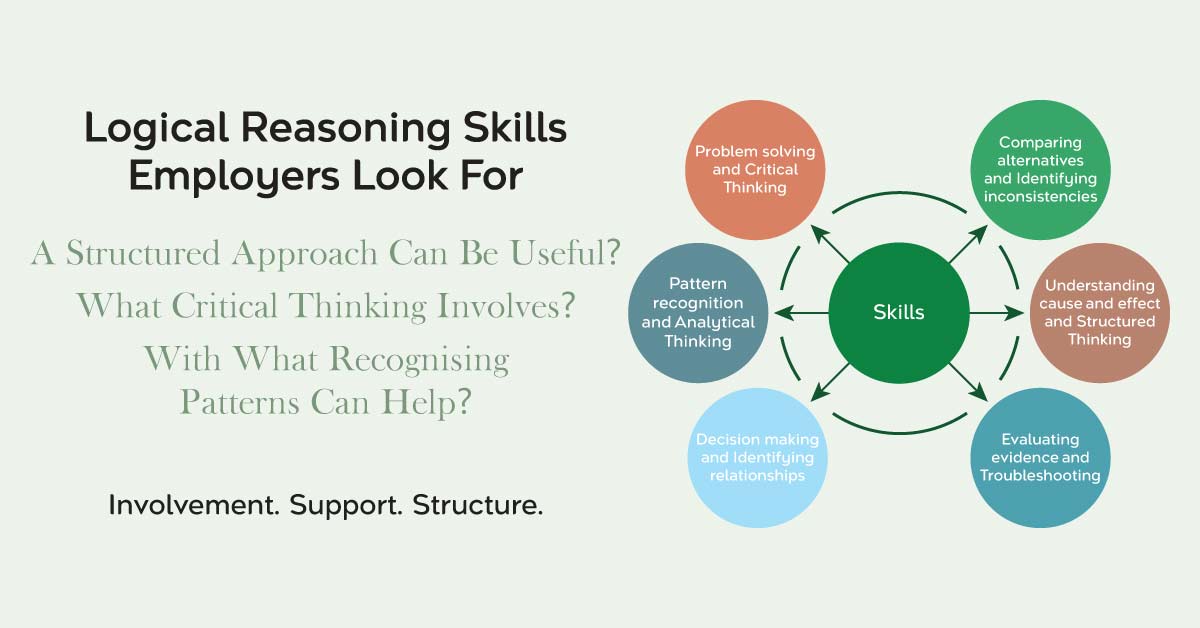
Logical Reasoning Skills Employers Look For
1. Problem-Solving
Problem-solving involves identifying a problem, understanding its causes, considering possible solutions, and selecting an appropriate approach.
At work, problems can range from technical errors to operational challenges and customer issues.
A strong problem solver does not necessarily jump immediately to the first possible solution.
Instead, they may:
- Define the problem.
- Gather relevant information.
- Identify possible causes.
- Consider different solutions.
- Evaluate the options.
- Take action.
- Review the outcome.
This structured approach can be useful across many professions.
2. Critical Thinking
Critical thinking involves evaluating information rather than accepting every claim at face value.
Employees may need to ask:
- Is the information reliable?
- What evidence supports this conclusion?
- Are there alternative explanations?
- What assumptions are being made?
- Is important information missing?
Critical thinking can be particularly useful in research, management, consulting, analysis, healthcare, technology, and other information-intensive environments.
3. Pattern Recognition
Pattern recognition involves identifying relationships or repeated structures within information.
For example, an employee might notice:
- A recurring technical problem
- A repeated customer behaviour
- A pattern in sales data
- A recurring production issue
- A relationship between different events
Recognising patterns can help professionals identify potential causes and opportunities.
4. Analytical Thinking
Analytical thinking involves breaking complex information into smaller parts and examining how those parts relate to one another.
An analyst might separate a large business problem into several smaller questions before attempting to solve it.
Analytical thinking can be useful in:
- Data analysis
- Finance
- Engineering
- Research
- Business
- Technology
- Operations
For more information about careers that use this type of thinking, see Analytical vs Creative Careers.
5. Decision-Making
Decision-making often requires evaluating different alternatives.
Employees may need to consider:
- Benefits
- Risks
- Costs
- Resources
- Time
- Available evidence
- Potential consequences
Logical reasoning can help structure this process.
However, good professional decisions are not always based exclusively on logic. Experience, professional judgement, values, communication, and contextual knowledge can also influence decisions.
6. Identifying Relationships
Many workplace problems involve understanding how different factors are connected.
For example:
A manager may notice that changes in staffing levels are associated with changes in productivity.
A developer may identify a relationship between one software component and a recurring error.
A financial analyst may identify a relationship between different business indicators.
Recognising relationships can help employees understand complex situations.
7. Evaluating Evidence
Employees frequently need to make decisions based on incomplete or competing information.
Evaluating evidence involves considering:
- The quality of the information
- Its relevance
- Its reliability
- Supporting evidence
- Contradictory evidence
- Possible explanations
This can help employees avoid making conclusions based solely on assumptions.
8. Troubleshooting
Troubleshooting involves systematically identifying the cause of a problem.
It is particularly important in technical and operational roles.
For example, a technician may need to determine why a system has stopped working.
Instead of randomly changing components, they can work through possible causes and eliminate explanations step by step.
This is a practical application of logical reasoning.
9. Understanding Cause and Effect
Understanding cause and effect can help professionals determine why something happened and what might happen if a particular action is taken.
For example, a business analyst may ask:
If we change this process, what could happen to cost, efficiency, and customer experience?
This type of thinking can support planning and decision-making.
10. Structured Thinking
Structured thinking involves organising information and approaching problems systematically.
Instead of treating a complex issue as one large problem, an employee can divide it into smaller components.
This can make complicated situations easier to understand and manage.
Structured thinking can be particularly useful in consulting, management, technology, research, engineering, and project-based work.
11. Comparing Alternatives
Professional decisions often involve multiple possible solutions.
Logical reasoning can help employees compare alternatives according to relevant criteria.
For example:
| Option | Cost | Time | Risk | Expected Result |
| A | Low | Short | Medium | Moderate |
| B | Medium | Medium | Low | High |
| C | High | Long | High | Potentially High |
The best option is not necessarily the one with the highest expected result.
Employees may need to balance several factors before making a decision.
12. Identifying Inconsistencies
Attention to inconsistencies can be valuable in many jobs.
An employee may notice:
- A number that does not match another report
- Information that contradicts previous findings
- A process that does not produce the expected result
- An unusual pattern in customer behaviour
Identifying these inconsistencies can help prevent errors and reveal problems that require further investigation.
Logical Reasoning in Different Careers
The reasoning skills employers look for can vary considerably between professions.
Technology
Technology roles can involve:
- Troubleshooting
- Pattern recognition
- Structured thinking
- Problem-solving
- Systems analysis
Finance
Finance roles may involve:
- Numerical analysis
- Evaluating evidence
- Comparing alternatives
- Risk assessment
- Decision-making
Engineering
Engineering can involve:
- Problem-solving
- Cause-and-effect analysis
- Systems thinking
- Technical reasoning
- Evaluating alternatives
Business
Business professionals may use reasoning to:
- Analyse performance
- Identify opportunities
- Evaluate risks
- Compare strategies
- Make decisions
Law
Legal professionals may need to:
- Analyse evidence
- Evaluate arguments
- Identify inconsistencies
- Interpret information
- Construct logical arguments
Research
Researchers can use logical reasoning when:
- Developing hypotheses
- Evaluating evidence
- Analysing results
- Comparing explanations
- Drawing conclusions
How Employers Assess Logical Reasoning
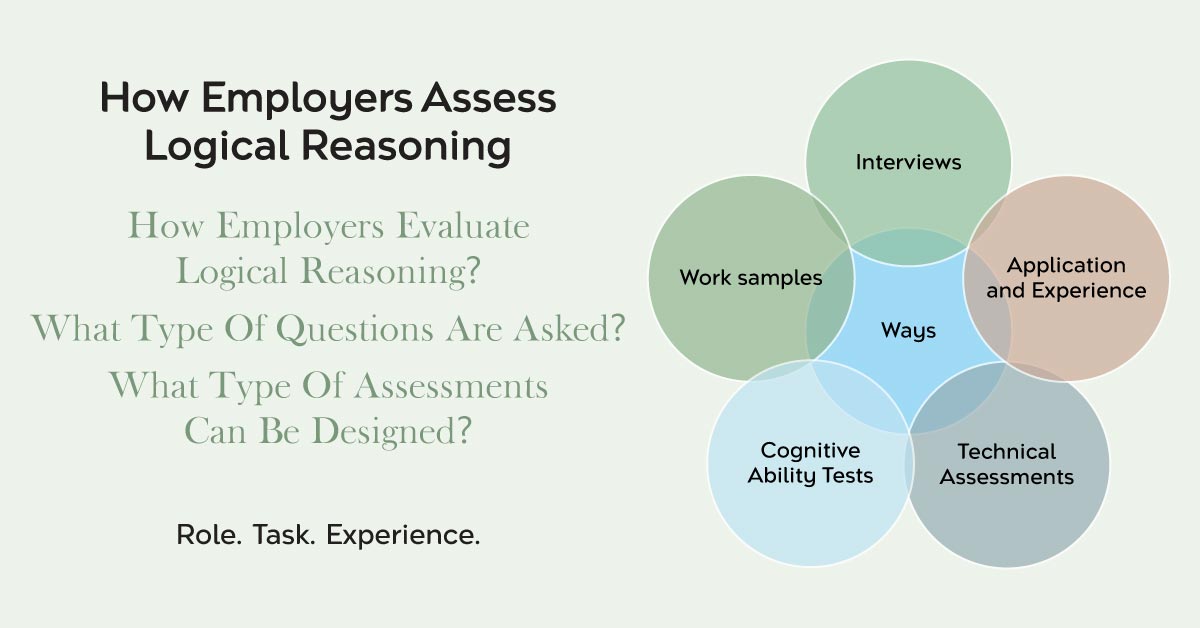
Employers can evaluate reasoning skills in several ways.
Interviews
Interviewers may ask candidates to describe how they handled a difficult problem or made an important decision.
Behavioural questions can provide examples of how someone approaches real-world situations.
Work Samples
Some employers ask candidates to complete tasks that resemble the actual work involved in the role.
This can provide information about practical problem-solving.
Cognitive Ability Tests
Some organisations use cognitive ability assessments that include reasoning tasks.
These may involve:
- Logical sequences
- Patterns
- Numerical relationships
- Verbal reasoning
- Problem-solving
For more information, see Why Employers Use Cognitive Ability Tests.
Technical Assessments
Technical roles may include assessments designed around job-specific problems.
For example, a software development candidate may complete a programming task rather than a general reasoning exercise.
Application and Experience
Previous work experience can also provide evidence of problem-solving and decision-making.
A candidate may demonstrate reasoning skills through projects, achievements, research, technical work, or other professional experiences.
Logical Reasoning Skills vs IQ
Logical reasoning can be one component of cognitive ability measured by some IQ tests.
However, logical reasoning and IQ are not identical concepts.
An IQ assessment may evaluate several cognitive abilities, depending on its design.
Logical reasoning is more specifically concerned with the ability to understand relationships, evaluate information, identify patterns, and draw conclusions.
A score from an IQ test should therefore not be treated as a complete description of someone's logical reasoning or professional potential.
For more information about IQ and work outcomes, see Does IQ Affect Career Success?
Logical Reasoning Skills vs Personality
Logical reasoning and personality describe different aspects of an individual.
Logical reasoning concerns certain cognitive processes.
Personality describes relatively consistent tendencies in how someone may think, feel, and behave.
For example, two employees may have similar reasoning abilities but different preferences for:
- Teamwork
- Structure
- Social interaction
- Independence
- Change
- Leadership
Both cognitive abilities and personality can therefore provide different information when considering career fit.
Can Logical Reasoning Be Improved?
Logical reasoning skills can be practised and developed.
Activities that may encourage structured thinking include:
- Solving logic problems
- Learning programming
- Studying mathematics
- Analysing data
- Playing strategy games
- Working through case studies
- Practising decision-making
- Investigating complex problems
Professional experience can also improve reasoning within a specific field.
Someone working in engineering, for example, develops not only reasoning skills but also technical knowledge that helps them apply those skills to engineering problems.
How to Demonstrate Logical Reasoning to Employers
Having a reasoning skill is one thing. Demonstrating it during recruitment is another.
You can demonstrate logical thinking by explaining:
The Problem
Clearly describe what needed to be solved.
Your Analysis
Explain what information you considered and why.
Your Approach
Describe how you compared options or identified possible causes.
Your Decision
Explain why you selected a particular solution.
The Result
Describe what happened after you took action.
This structure can make your reasoning process easier for an interviewer to understand.
Examples of Logical Reasoning at Work
Example 1: Data Analysis
A data analyst notices that customer cancellations have increased.
Instead of immediately assuming why, they examine the data by customer type, product, location, and time period.
They identify a pattern and investigate the potential cause.
Example 2: Technical Problem
A software developer notices that an application repeatedly fails under certain conditions.
They identify the circumstances in which the problem occurs, examine the relevant components, test possible causes, and evaluate the results.
Example 3: Business Decision
A manager must choose between several suppliers.
They compare price, reliability, delivery time, quality, and potential risks rather than focusing only on cost.
These examples demonstrate that logical reasoning is often about how information is analysed, not simply about getting a correct answer.
Can Logical Reasoning Help With Career Choice?
Yes, logical reasoning can be one useful factor when exploring careers.
If you enjoy analysing problems, identifying patterns, working with systems, or evaluating information, you may want to investigate careers where these activities are common.
Potential areas include:
- Technology
- Engineering
- Finance
- Data
- Research
- Business analysis
- Consulting
- Science
However, interest matters too.
A person can have strong logical reasoning skills without enjoying work that requires extensive analysis.
This is why career exploration should consider multiple characteristics rather than one ability.
Logical Reasoning and Career Aptitude Tests
A career aptitude test can provide a broader perspective than a reasoning assessment alone.
Depending on the assessment, it may explore:
- Interests
- Personality
- Strengths
- Abilities
- Work preferences
This can help you consider whether your reasoning abilities align with the types of work you actually enjoy.
For example, someone with strong analytical abilities may prefer an analytical career, while another person with similar abilities may prefer a people-oriented role where analytical thinking is only one part of the job.
To understand the broader factors a career aptitude test may examine, see What Does a Career Aptitude Test Measure?
Conclusion
Logical reasoning can be valuable across a wide range of careers.
Employers may look for abilities such as problem-solving, critical thinking, pattern recognition, analytical thinking, decision-making, troubleshooting, and structured thinking.
However, the importance of each skill depends on the role.
A strong logical thinker may be well suited to certain analytical or technical careers, but professional success involves much more than reasoning ability alone.
If logical reasoning is one of your strengths, consider it alongside your interests, personality, other abilities, and preferred working environment when exploring career options.
A career aptitude test can provide additional perspective by helping you consider several characteristics together rather than focusing on one ability.
Ready to explore careers that match your broader profile? Take our Career Aptitude Test and discover potential career paths worth exploring.

