

What Is Cognitive Ability?
Cognitive ability refers to the mental skills people use to understand information, solve problems, learn, reason, make decisions, and adapt to new situations. These abilities play a role in many everyday activities, from learning a new concept to evaluating information and finding solutions to unfamiliar problems.
Cognitive ability can include several different mental skills rather than one single ability. Depending on the context, it may involve reasoning, memory, attention, processing information, problem-solving, and learning.
Understanding cognitive ability can be useful when exploring education, career development, workplace performance, and cognitive assessments. However, cognitive ability is only one part of how people learn, work, and perform. Motivation, personality, experience, knowledge, communication, and other factors can also influence outcomes.
What Are the Main Types of Cognitive Ability?
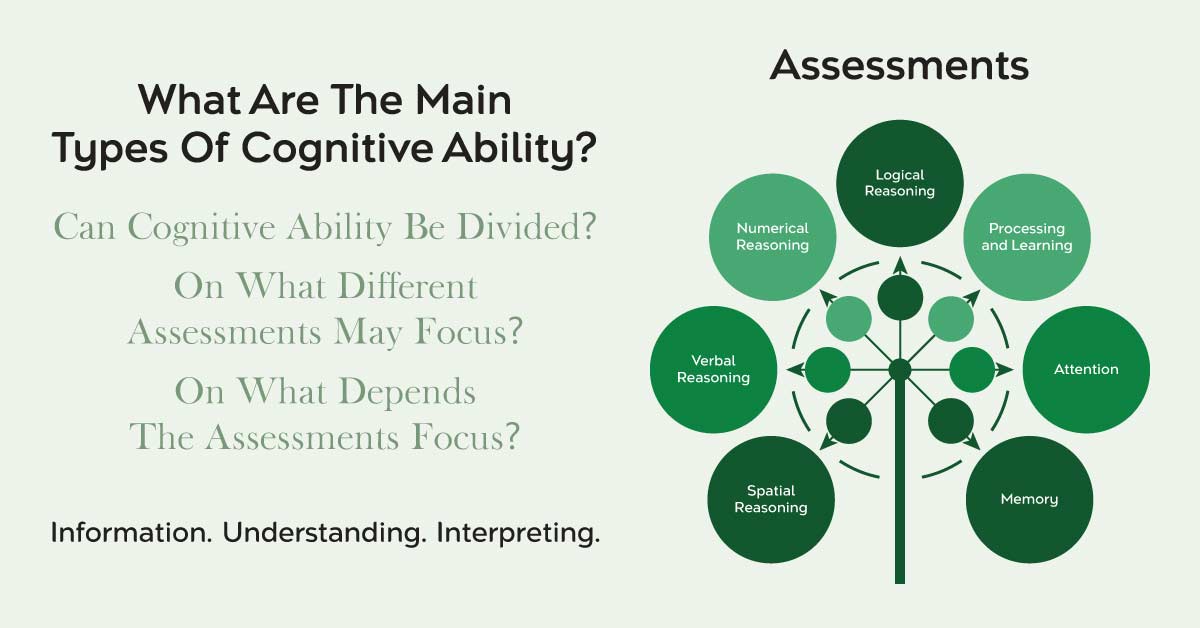
Cognitive ability can be divided into several related areas. Different assessments may focus on different abilities, depending on their purpose.
1. Logical Reasoning
Logical reasoning involves using information and relationships between ideas to reach a conclusion.
It can be useful when identifying patterns, evaluating possibilities, solving problems, or determining what follows logically from available information.
For example, a person might use logical reasoning to identify which solution best fits a set of conditions.
2. Verbal Reasoning
Verbal reasoning involves understanding and working with written or spoken information.
It can include interpreting statements, identifying relationships between words or ideas, and drawing conclusions from written information.
Verbal reasoning can be relevant in careers where professionals regularly need to understand instructions, reports, policies, or other forms of written information.
3. Numerical Reasoning
Numerical reasoning involves understanding and interpreting numerical information.
This can include comparing numbers, identifying numerical relationships, working with percentages, or interpreting tables and charts.
Numerical reasoning can be useful in areas such as finance, business, engineering, science, technology, and many other fields.
4. Spatial Reasoning
Spatial reasoning involves understanding objects, shapes, positions, and relationships in space.
For example, someone may need to mentally rotate an object, understand how parts fit together, or interpret a diagram.
Spatial reasoning can be particularly relevant in areas involving design, engineering, architecture, construction, manufacturing, and technical work.
5. Memory
Memory allows people to retain and retrieve information.
Different forms of memory support different activities. Remembering instructions, recalling information from previous learning, and recognizing familiar patterns all involve memory processes.
Memory is therefore an important part of learning and many everyday tasks.
6. Attention
Attention involves focusing mental resources on relevant information.
Being able to concentrate on a task, filter out distractions, and shift attention when necessary can support learning and problem-solving.
The role of attention can vary depending on the environment and the complexity of the task.
7. Processing and Learning
Cognitive ability can also involve how people process new information and learn from experience.
When someone encounters an unfamiliar task, they may need to understand the information, identify what matters, learn the relevant process, and apply that knowledge.
Learning ability can therefore be important when people need to adapt to changing tasks, technologies, or working environments.
Why Is Cognitive Ability Important?
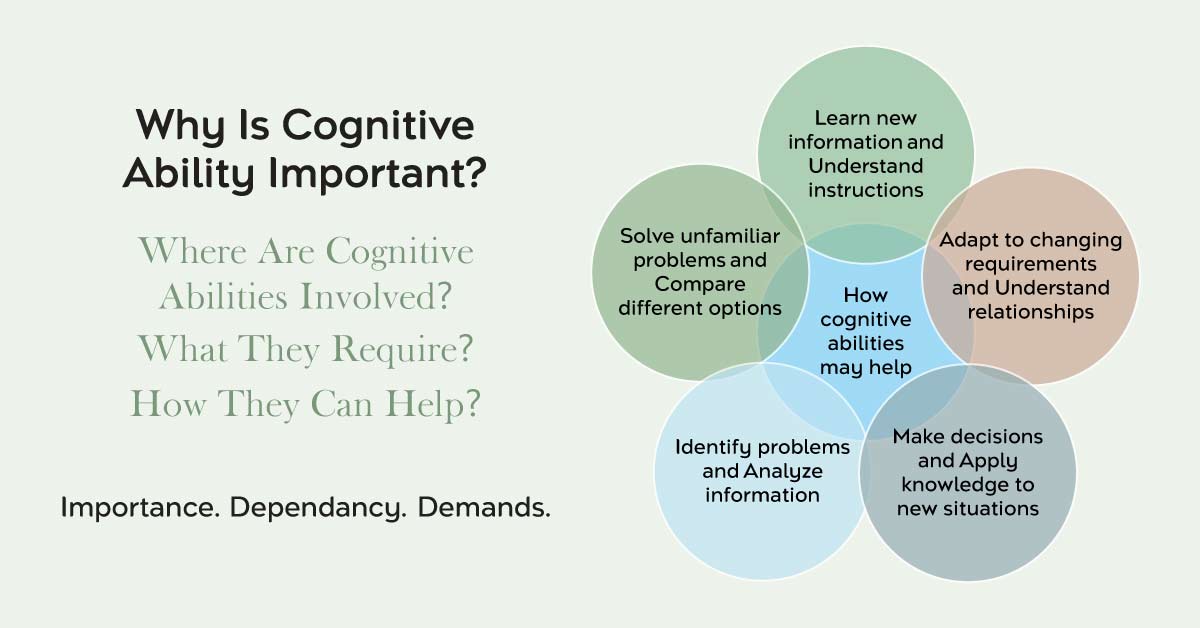
Cognitive abilities are involved in many activities that require people to understand information and respond appropriately.
For example, cognitive abilities may help people:
- Learn new information
- Understand instructions
- Solve unfamiliar problems
- Compare different options
- Identify patterns
- Analyze information
- Make decisions
- Apply knowledge to new situations
- Adapt to changing requirements
- Understand relationships between ideas
The importance of particular cognitive abilities depends on the situation. A job that involves interpreting financial data may place different demands on cognitive skills than a role involving spatial design or written communication.
Cognitive Ability in the Workplace
Cognitive ability can play a role in many workplace activities.
Employees may need to understand new information, troubleshoot problems, interpret data, learn new systems, or make decisions based on available evidence.
For example, a software developer may need to analyze a technical problem, while an accountant may need to interpret numerical information. A researcher may evaluate evidence, and a project manager may compare possible solutions.
This does not mean that cognitive ability alone determines workplace performance. Professional knowledge, experience, communication, teamwork, motivation, personality, and other factors can also be important.
For a closer look at why organizations may use cognitive assessments, see our article on [why employers use cognitive ability tests].
What Is a Cognitive Ability Test?
A cognitive ability test is an assessment designed to measure one or more mental abilities.
Depending on the assessment, it may include questions involving areas such as:
- Logical reasoning
- Verbal reasoning
- Numerical reasoning
- Spatial reasoning
- Pattern recognition
- Problem-solving
- Memory or attention
Different cognitive ability tests can have different purposes and formats. Some focus on a specific skill, while others combine several types of cognitive tasks.
The results should be interpreted according to what the assessment is designed to measure rather than being treated as a complete description of a person's abilities.
Cognitive Ability vs IQ
Cognitive ability and IQ are closely related concepts, but they are not necessarily interchangeable.
Cognitive ability is a broad term describing different mental skills involved in activities such as reasoning, learning, understanding information, and problem-solving.
IQ, or intelligence quotient, generally refers to scores from standardized intelligence assessments designed to estimate aspects of cognitive functioning.
An IQ score can provide information about performance on particular cognitive tasks, but it should not be interpreted as a complete measure of everything that contributes to learning, work performance, or career success.
For more context, see our article on [does IQ affect career success].
Cognitive Ability vs Logical Reasoning
Logical reasoning is one type of cognitive ability.
Cognitive ability is the broader concept, while logical reasoning focuses more specifically on using relationships, rules, and information to reach conclusions.
For example, a person may use logical reasoning to determine which statement follows from a set of facts. Other cognitive tasks may involve numerical information, verbal information, memory, spatial relationships, or learning.
Our article on [jobs that require strong logical reasoning] explores how reasoning skills can be relevant to different career paths.
Cognitive Ability vs Personality
Cognitive ability and personality describe different aspects of an individual.
Cognitive ability generally relates to mental processes such as reasoning, learning, memory, and problem-solving. Personality describes relatively consistent patterns in how people tend to think, feel, and behave.
For example, a person may have strong reasoning abilities while also being highly conscientious, outgoing, curious, or emotionally reserved.
Both cognitive characteristics and personality characteristics can provide different types of information when someone is exploring education or career options.
Does Cognitive Ability Affect Career Choice?
Cognitive ability can be relevant when considering career options, particularly because different occupations involve different types of cognitive demands.
For example, some careers may involve substantial numerical reasoning, while others may require verbal analysis, spatial thinking, problem-solving, or learning complex systems.
However, cognitive ability should not be used on its own to decide whether someone is suited for a particular career.
Career interests, personality, values, skills, education, experience, preferred work environment, and practical circumstances can all contribute to career decisions.
A career assessment can be one source of information that helps people reflect on these different factors. Our article on [what a career aptitude test measures] explains some of the areas that career-focused assessments may explore.
Can Cognitive Ability Be Improved?
Some cognitive skills can be developed or strengthened through learning, practice, experience, and strategies.
For example, people can develop greater familiarity with numerical concepts, improve problem-solving approaches, learn new information, and become more effective at handling specific types of tasks.
However, improvement in one particular skill does not necessarily mean that every aspect of cognitive ability will change in the same way.
Cognitive performance can also be influenced by factors such as familiarity with a task, education, experience, attention, fatigue, stress, and the environment in which a task is performed.
How Can You Demonstrate Cognitive Skills at Work?
You do not necessarily need to take a cognitive assessment to demonstrate cognitive abilities.
Workplace examples can include:
- Explaining how you solved a difficult problem
- Showing how you analyzed information before making a decision
- Describing how you learned a new system
- Explaining how you identified an error
- Showing how you compared several possible solutions
- Demonstrating how you used data to support a recommendation
- Describing how you adapted when circumstances changed
When discussing these examples in an interview, focus on the situation, the information you considered, the reasoning process you used, and the outcome.
How Are Cognitive Abilities Assessed?
Cognitive abilities can be assessed in different ways depending on the purpose.
Some assessments use structured questions designed to examine specific types of reasoning or problem-solving. Others may use multiple sections to explore several cognitive areas.
Cognitive abilities can also be considered through practical tasks, work samples, academic activities, interviews, or other forms of evaluation.
No single assessment necessarily captures every aspect of how someone thinks or performs in every real-world situation.
Cognitive Ability and Career Assessments
Career assessments may consider cognitive characteristics alongside other information that can be relevant to career exploration.
For example, a career-focused assessment may help someone reflect on interests, preferences, strengths, or potential career areas, while a cognitive assessment may focus more specifically on mental abilities such as reasoning or problem-solving.
This distinction is important because career choice is broader than cognitive ability alone.
If you are exploring possible career directions, a [career aptitude test] can be one starting point for understanding how different personal characteristics may relate to potential career options.

