

Best Jobs for Curious and Open-Minded People
Published on: September 09, 2026
By : Ariadna Miles
Best Jobs for Curious and Open-Minded People
Introduction
Some people are naturally curious. They enjoy learning new things, exploring different perspectives, asking questions, and discovering unfamiliar ideas.
They may become easily interested in new subjects and enjoy careers that offer variety, learning opportunities, creativity, or intellectual challenges.
These characteristics are often associated with openness to experience, one of the five broad dimensions of personality in the Big Five personality model.
People who are relatively high in openness may enjoy exploring new possibilities, thinking creatively, and approaching problems from different perspectives. These characteristics can be useful in many professional environments, particularly careers involving learning, innovation, research, creativity, or variety.
However, being curious and open-minded does not automatically determine which career is right for you. Career choice also depends on your interests, abilities, strengths, values, personality, education, experience, and preferred work environment.
In this guide, we'll explore jobs that may appeal to curious and open-minded people, the strengths associated with openness, and how to use personality insights when exploring potential career paths.
What Does It Mean to Be Curious and Open-Minded?
Curiosity involves a desire to learn, understand, discover, and explore.
Open-mindedness involves being willing to consider different ideas, perspectives, experiences, and possibilities.
People who are highly curious or open-minded may enjoy:
- Learning about unfamiliar subjects
- Exploring new ideas
- Asking questions
- Trying different approaches
- Discovering new information
- Understanding different perspectives
- Solving unusual problems
- Exploring creative possibilities
- Adapting to new experiences
These characteristics can be useful across many different careers.
Curiosity does not necessarily mean constantly changing jobs or seeking excitement. A curious person may be perfectly happy in a specialised career if the role provides opportunities to learn and develop expertise.
Openness to Experience and Career Choice
In the Big Five personality model, openness to experience is associated with characteristics such as curiosity, imagination, intellectual exploration, creativity, and interest in new experiences.
People who score relatively high in openness may prefer careers that offer:
- Learning opportunities
- Variety
- Intellectual stimulation
- Creative freedom
- Innovation
- Exploration
- Exposure to different ideas
- Opportunities to solve new problems
However, personality scores should not be treated as career instructions.
Two people with similar levels of openness may have completely different interests and abilities.
One person may enjoy scientific research, while another may prefer writing, design, technology, education, or entrepreneurship.
Strengths Often Associated With Curious People
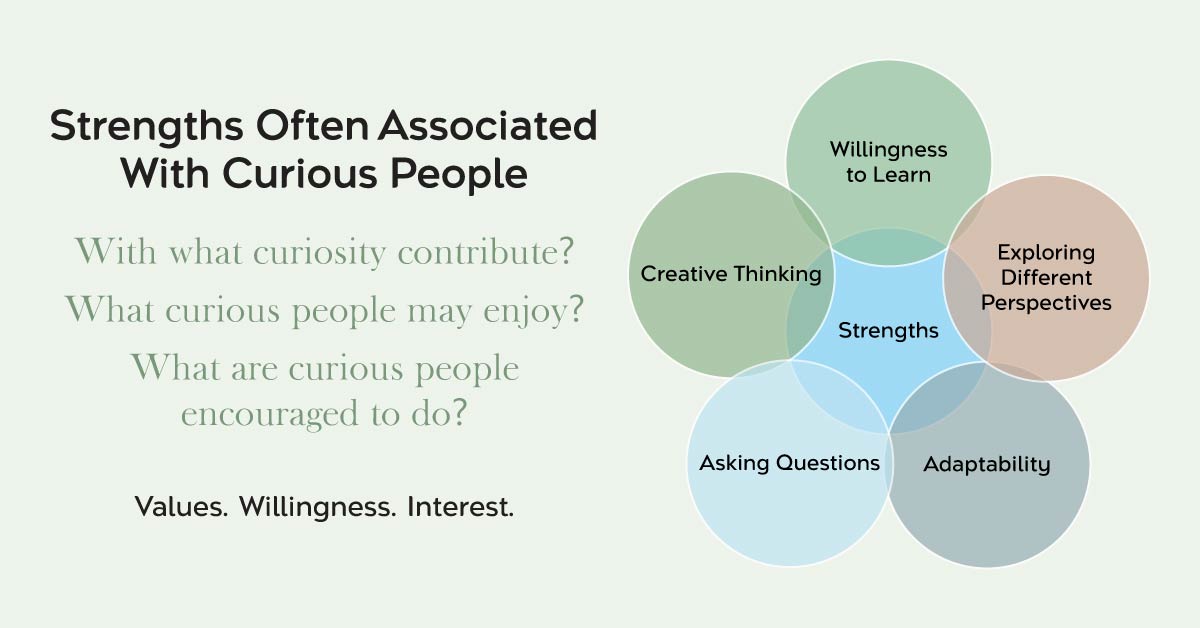
Curiosity can contribute to several useful professional qualities.
Willingness to Learn
Curious people may enjoy acquiring new knowledge and developing new skills.
This can be valuable in industries where technology, knowledge, and practices change regularly.
Creative Thinking
Curiosity can encourage people to explore possibilities and consider alternatives.
This may support creative problem-solving and innovation.
Asking Questions
Curious professionals may be willing to ask questions rather than simply accepting existing assumptions.
This can help uncover problems, identify opportunities, and improve processes.
Adaptability
An interest in new experiences may make some people more comfortable with change.
This can be useful in industries where responsibilities, technology, or market conditions evolve quickly.
Exploring Different Perspectives
Open-minded people may be interested in understanding viewpoints different from their own.
This can be useful in areas such as research, education, communications, international business, and social sciences.
Best Jobs for Curious and Open-Minded People
There is no single list of careers that is right for every curious person.
However, certain career areas may provide opportunities for exploration, learning, creativity, or intellectual challenge.
Researcher
Research careers involve asking questions, gathering information, analysing evidence, and developing new knowledge.
Researchers can work in areas such as:
- Science
- Psychology
- Medicine
- Technology
- Social sciences
- Market research
- Education
Research may appeal to people who enjoy investigating questions and discovering new information.
Writer
Writing can provide opportunities to explore ideas, research subjects, communicate perspectives, and create original content.
Potential career paths include:
- Content writer
- Copywriter
- Journalist
- Technical writer
- Author
- Editor
- Content strategist
Different writing careers require different combinations of creativity, research, communication, and technical knowledge.
Journalist
Journalism often involves investigating subjects, interviewing people, researching information, and communicating findings to an audience.
The work can expose journalists to different topics, people, and perspectives.
It may therefore appeal to people who enjoy asking questions and discovering information.
Teacher or Educator
Education can provide continuous opportunities to learn and explore new subjects.
Teachers may:
- Research topics
- Develop lessons
- Explain ideas
- Adapt teaching approaches
- Explore new educational methods
Curiosity can also help educators remain interested in their subject and continue developing professionally.
Scientist
Scientific careers are built around questions, observation, experimentation, analysis, and discovery.
Scientists may investigate problems that do not have immediate or obvious answers.
Potential fields include:
- Biology
- Chemistry
- Physics
- Environmental science
- Astronomy
- Neuroscience
- Materials science
Scientific careers generally require specialised education and technical knowledge.
Software Developer
Technology changes rapidly, creating ongoing opportunities for learning and experimentation.
Software developers may work on:
- New applications
- Digital products
- Automation
- Artificial intelligence
- Web platforms
- Mobile applications
- Technical solutions
Software development combines analytical thinking with creativity and problem-solving.
UX Designer
UX design involves understanding how people interact with products and developing ways to improve their experiences.
UX professionals may:
- Research users
- Identify problems
- Develop ideas
- Create prototypes
- Test solutions
- Analyse feedback
The combination of research, psychology, creativity, and problem-solving may appeal to curious people.
Entrepreneur
Entrepreneurship can provide significant variety and opportunities to explore new ideas.
Entrepreneurs may work on:
- Identifying opportunities
- Developing products
- Researching markets
- Testing ideas
- Building businesses
- Solving customer problems
However, entrepreneurship also involves uncertainty, financial risk, planning, and responsibility. Curiosity alone is not enough to succeed.
Marketing Specialist
Marketing involves understanding audiences, researching markets, developing ideas, testing messages, and analysing results.
Some marketing roles combine:
- Research
- Creativity
- Communication
- Psychology
- Data analysis
- Strategy
This combination may appeal to people who enjoy both learning and experimentation.
Consultant
Consultants typically work with different organisations or clients to analyse problems and develop recommendations.
Depending on the field, consultants may encounter different:
- Industries
- Business models
- Challenges
- Teams
- Markets
The variety can appeal to people who enjoy learning about new situations.
Architect
Architecture combines creativity, technical knowledge, research, planning, and problem-solving.
Architects may explore:
- New design concepts
- Materials
- Technologies
- Environmental considerations
- User needs
- Structural solutions
It can therefore appeal to people who enjoy combining creative and analytical thinking.
Product Manager
Product management involves understanding customer needs, researching markets, analysing information, defining priorities, and working with teams to develop products.
The role can involve continuous learning and exposure to different areas of a business.
Careers That Combine Curiosity and Creativity
Curious people do not necessarily need to choose careers traditionally described as “creative.”
Many careers combine curiosity with structured problem-solving.
Examples include:
- Product design
- Data science
- Research
- Engineering
- Marketing
- Architecture
- Technology
- Business strategy
- Psychology
- Environmental science
For example, a data scientist may explore patterns in data and develop new approaches to solving problems.
An engineer may investigate technical challenges and design new solutions.
A marketer may research consumer behaviour and develop creative campaigns.
Curiosity can therefore be valuable in both creative and analytical environments.
Careers That Offer Variety
Some curious people may particularly enjoy careers where projects, clients, subjects, or responsibilities change regularly.
Potential examples include:
- Consulting
- Journalism
- Marketing
- Event management
- Sales
- Recruitment
- Entrepreneurship
- Project management
- Travel-related careers
- Research
However, variety is not necessarily better for everyone.
Some people prefer developing deep expertise in one area rather than constantly changing subjects.
Understanding your own preferences is therefore important.
How Personality Can Influence Career Preferences
Personality can influence the types of activities and environments people prefer.
For example, a person with high openness may enjoy exploration and new ideas.
A highly conscientious person may prefer structure, planning, and clearly defined goals.
An extroverted person may enjoy frequent interaction, while an introverted person may prefer focused independent work.
These traits can overlap.
A person can be highly curious and introverted, for example, and may enjoy research, writing, programming, or other careers that provide intellectual exploration with periods of independent work.
Personality is therefore more useful as a source of self-understanding than as a system for assigning careers.
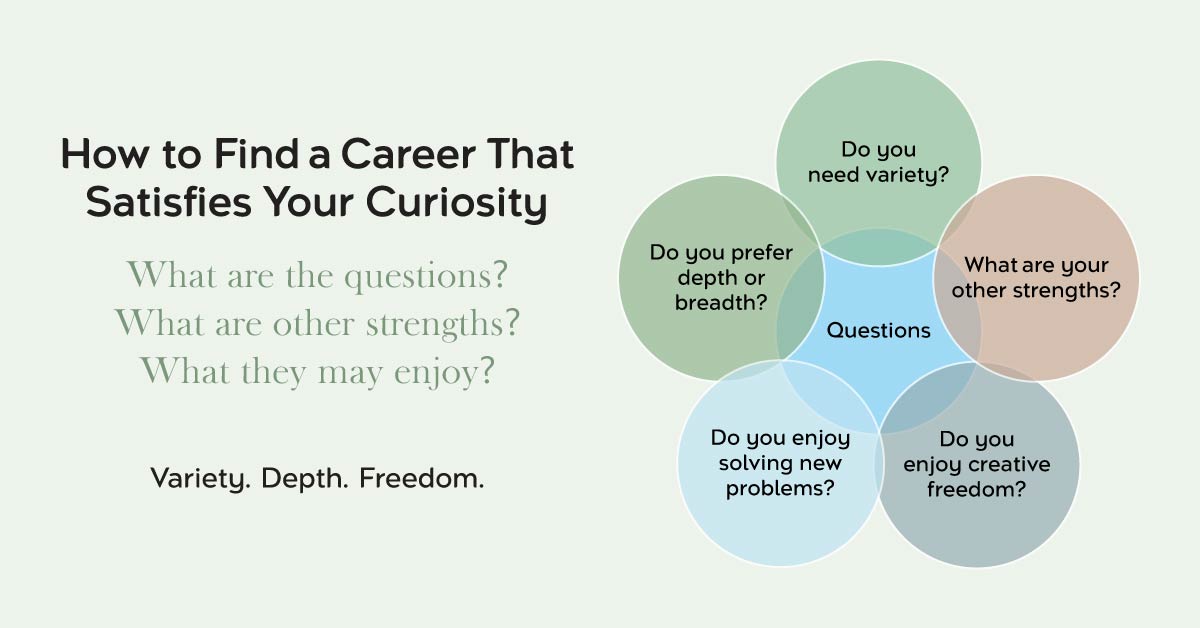
How to Find a Career That Satisfies Your Curiosity
If you are highly curious or open-minded, consider the following questions.
Do You Need Variety?
Ask yourself whether you enjoy:
- Working on different projects
- Learning about different subjects
- Meeting new people
- Changing responsibilities
- Exploring new environments
If variety is important to you, look for careers where projects or responsibilities change regularly.
Do You Prefer Depth or Breadth?
Curiosity can take different forms.
You may enjoy learning a little about many subjects.
Or you may become deeply interested in one subject and spend years developing expertise.
Both approaches can lead to fulfilling careers.
Do You Enjoy Solving New Problems?
Consider whether you prefer familiar tasks or situations where you need to figure something out for the first time.
If you enjoy unfamiliar problems, careers involving research, consulting, innovation, design, or technology may be worth exploring.
Do You Enjoy Creative Freedom?
Some curious people enjoy having freedom to experiment.
Consider whether you prefer:
- Clearly defined instructions
- Flexible objectives
- Open-ended projects
- Experimentation
- Developing your own approaches
Understanding this preference can help you evaluate different workplaces.
What Are Your Other Strengths?
Curiosity is only one characteristic.
You may also have strengths in:
- Communication
- Mathematics
- Writing
- Technology
- Leadership
- Research
- Organisation
- Problem-solving
- Creativity
The strongest career fit may come from the combination of several characteristics.
Can a Career Aptitude Test Help?
If you are unsure which career direction to explore, a career aptitude test can provide another perspective.
A broader assessment may consider:
- Interests
- Personality
- Strengths
- Abilities
- Work preferences
This can help you explore career areas that match several aspects of your profile.
For example, two people may both be highly curious but have very different career interests.
One may be interested in science and technology.
Another may be interested in writing, education, or marketing.
A career assessment can therefore help generate possibilities rather than provide one predetermined answer.
Using Personality Insights When Exploring Careers
Personality insights can help you understand what types of work environments may feel comfortable and motivating.
If you discover that you enjoy learning, variety, experimentation, and new ideas, you can look for careers that provide opportunities to use these characteristics.
At the same time, consider practical factors such as:
- Required education
- Salary expectations
- Working hours
- Location
- Job availability
- Career progression
- Required skills
The goal is to find a career that fits your broader priorities rather than simply matching one personality trait.
Common Mistakes Curious People Should Avoid
Chasing Novelty All the Time
Curiosity can make new opportunities exciting, but constantly changing direction can make it difficult to develop expertise.
Sometimes staying with a subject long enough to develop deep knowledge can be highly rewarding.
Choosing a Career Only Because It Sounds Interesting
A career may sound exciting without matching your preferred daily activities.
Research what professionals actually do each day before making a decision.
Assuming You Need a Creative Career
Curiosity can be valuable in science, technology, finance, healthcare, education, business, and many other areas.
You do not have to work in an artistic profession to use curiosity and creativity.
Ignoring Your Other Characteristics
Career choice should consider more than openness or curiosity.
Your abilities, interests, values, personality, work preferences, and practical circumstances all matter.
Expecting a Test to Choose Your Career
Personality and career assessments can provide useful guidance, but they should not make the decision for you.
Use assessment results as a starting point for exploration.
Conclusion
Curious and open-minded people may enjoy careers that provide opportunities to learn, explore ideas, solve new problems, and discover different perspectives.
Potential career paths include research, writing, journalism, science, technology, UX design, marketing, consulting, education, architecture, and entrepreneurship.
However, curiosity alone does not determine the right career.
A fulfilling career is more likely to come from the combination of your interests, abilities, strengths, personality, values, work preferences, and long-term goals.
If you are naturally curious, focus on finding work that gives you opportunities to keep learning while also matching the other characteristics that matter to you.
A career aptitude test can provide another perspective and help you identify career areas worth exploring.
Ready to explore careers that may match your interests, strengths, and abilities? Take our Career Aptitude Test and discover potential career paths.

