

Numerical Reasoning and Career Performance
Published on: October 02, 2026
By : Teddy Bridges
Numerical Reasoning and Career Performance
Introduction
Numerical reasoning is an important skill in many areas of work.
It involves understanding numbers, identifying numerical relationships, interpreting data, and using quantitative information to solve problems or make decisions.
Some careers rely heavily on numerical reasoning, including finance, accounting, engineering, data analysis, economics, and certain business and technical roles.
However, numerical reasoning is only one factor that can influence career performance. Professional success can also depend on knowledge, experience, communication, motivation, personality, attention to detail, and other job-related skills.
Understanding your numerical reasoning abilities can therefore be useful when exploring career options, particularly when combined with information about your interests, personality, strengths, and work preferences.
In this guide, we'll explain numerical reasoning and career performance, which careers commonly use numerical reasoning, and how this ability can fit into the bigger picture of career choice.
What Is Numerical Reasoning?
Numerical reasoning is the ability to understand and work with numerical information.
It can involve:
- Identifying numerical relationships
- Comparing quantities
- Understanding percentages
- Interpreting tables and charts
- Working with ratios
- Analysing numerical data
- Identifying patterns
- Applying mathematical concepts to problems
Numerical reasoning is different from simply being able to perform mathematical calculations.
For example, a person may know how to calculate a percentage but still need to understand what that percentage means in a particular situation.
Numerical reasoning involves using numerical information to understand situations and reach reasonable conclusions.
Why Is Numerical Reasoning Important at Work?
Many workplaces involve some form of numerical information.
Employees may need to:
- Understand financial information
- Compare results
- Analyse performance data
- Estimate costs
- Interpret statistics
- Identify trends
- Evaluate measurements
- Make decisions based on quantitative information
The level of numerical reasoning required varies significantly between occupations.
A financial analyst may work with numbers throughout most of the day, while a marketing professional may only occasionally need to interpret campaign data.
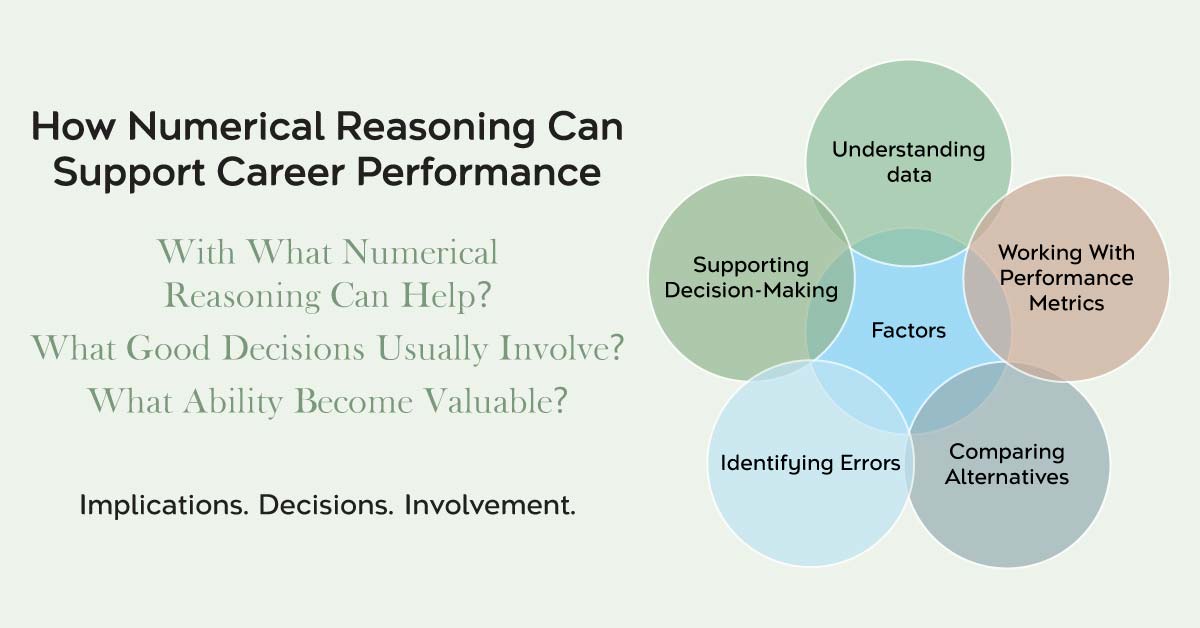
How Numerical Reasoning Can Support Career Performance
1. Understanding Data
Modern workplaces increasingly rely on data.
Employees may encounter information in:
- Spreadsheets
- Dashboards
- Reports
- Charts
- Graphs
- Financial statements
- Performance metrics
Numerical reasoning can help professionals understand what the data is showing and identify meaningful patterns.
2. Supporting Decision-Making
Business and professional decisions often involve quantitative information.
For example, a manager may compare costs and expected results before choosing between different options.
Numerical reasoning can help someone evaluate these figures and understand the potential implications.
However, good decisions usually involve more than numbers. Context, experience, risks, objectives, and qualitative information can also matter.
3. Identifying Errors
Numerical reasoning can help professionals recognise unusual or inconsistent information.
For example, an employee reviewing financial data might notice that a figure does not appear consistent with the surrounding information.
The ability to identify potential errors can be valuable in roles where accuracy is important.
4. Comparing Alternatives
Many professional decisions involve comparing different options.
Numerical information may help professionals compare:
- Costs
- Revenues
- Time requirements
- Performance
- Risks
- Resources
Understanding these differences can support more informed decision-making.
5. Working With Performance Metrics
Many organisations track performance using numerical indicators.
These might include:
- Sales figures
- Revenue
- Customer numbers
- Conversion rates
- Production levels
- Project costs
- Completion times
Employees who understand these metrics can often interpret performance information more effectively.
Careers That Require Strong Numerical Reasoning
Some professions involve numerical reasoning much more extensively than others.
Financial Analyst
Financial analysts evaluate financial information to support investment or business decisions.
Their work may involve:
- Financial statements
- Forecasts
- Financial models
- Market information
- Performance analysis
Strong numerical and analytical skills can be useful in this type of role.
Accountant
Accountants work extensively with financial information.
Their responsibilities may include:
- Recording transactions
- Analysing financial records
- Preparing reports
- Reviewing figures
- Applying accounting principles
Accuracy and attention to detail are particularly important.
Data Analyst
Data analysts work with datasets to identify patterns and communicate findings.
Numerical reasoning can help them interpret quantitative information and determine whether conclusions are supported by the data.
Technical skills, statistics, analytical thinking, and communication are also important.
Engineer
Engineering often involves applying mathematical and scientific principles to practical problems.
Depending on the engineering field, professionals may work with:
- Measurements
- Calculations
- Models
- Technical specifications
- Performance data
Engineering also requires extensive technical knowledge and specialised education.
Economist
Economists analyse economic information and relationships.
Their work may involve:
- Statistical analysis
- Economic models
- Data interpretation
- Forecasting
- Research
Numerical reasoning is often important, alongside economics knowledge and analytical skills.
Actuary
Actuaries use mathematics, statistics, and other analytical methods to evaluate uncertainty and financial risk.
Their work can involve highly quantitative models and calculations.
Actuarial careers generally require specialised education and professional qualifications.
Business Analyst
Business analysts examine information about organisations, processes, and performance.
Numerical reasoning can help when analysing:
- Costs
- Performance metrics
- Business data
- Resource use
- Operational results
Communication and problem-solving are also important because analysts often need to explain their findings to others.
Operations Research Analyst
Operations research analysts use analytical methods to help organisations solve complex problems.
They may work with numerical models involving:
- Resources
- Scheduling
- Costs
- Logistics
- Capacity
This career can require strong quantitative and analytical abilities.
Other Careers Where Numerical Reasoning Can Be Useful
Numerical reasoning can also be valuable in many other occupations, including:
- Statistician
- Financial planner
- Auditor
- Market researcher
- Supply chain analyst
- Economist
- Researcher
- Pharmacist
- Project manager
- Sales analyst
- Risk analyst
- Business consultant
- Data scientist
- Survey researcher
The level of numerical reasoning required varies between roles and industries.
Numerical Reasoning and IQ Tests
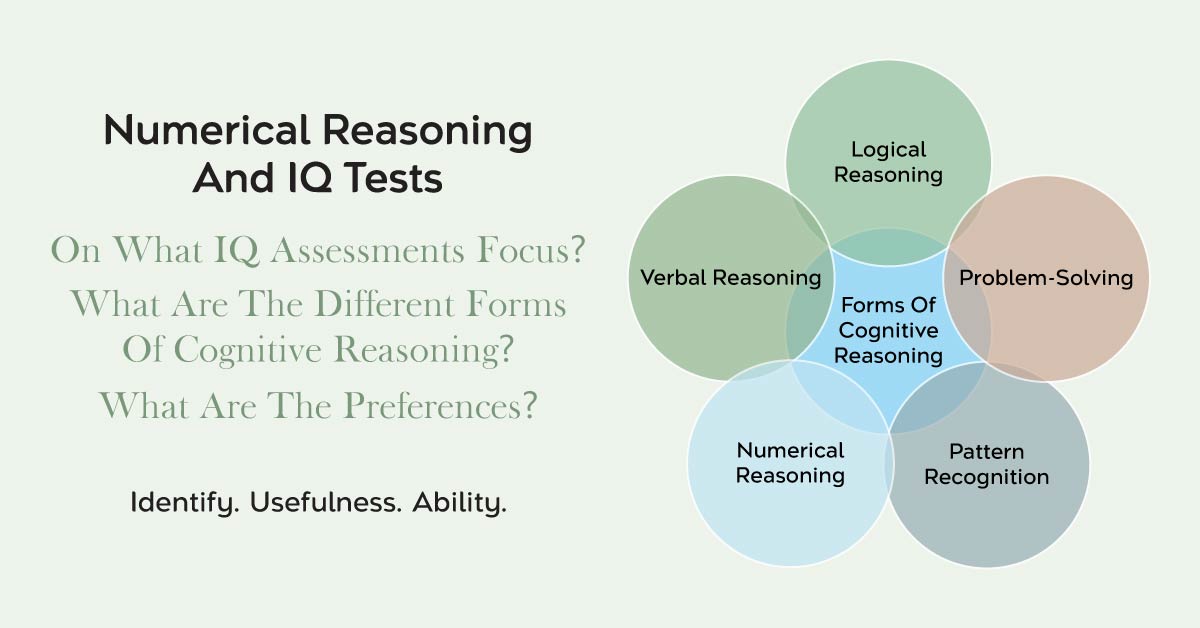
Numerical reasoning can be one component of a cognitive ability or IQ assessment, depending on the test.
Such assessments may also include:
- Logical reasoning
- Verbal reasoning
- Pattern recognition
- Abstract reasoning
- Problem-solving
However, not every IQ test measures numerical reasoning in the same way.
An assessment score should therefore be interpreted according to the specific abilities and test design involved.
For more information about IQ and professional outcomes, see Does IQ Affect Career Success?
Numerical Reasoning and Cognitive Ability Tests
Numerical reasoning can be one of these abilities.
For example, an assessment might ask candidates to interpret tables, calculate percentages, identify numerical patterns, or compare quantitative information.
This type of assessment can provide information about numerical reasoning under standardised conditions.
However, workplace performance also depends on practical knowledge, experience, training, and the ability to apply numerical information within a real-world context.
For more information, see Why Employers Use Cognitive Ability Tests.
Numerical Reasoning and Career Aptitude Tests
A career aptitude test generally has a broader purpose than a numerical reasoning assessment.
Instead of focusing exclusively on numerical ability, a career aptitude test may explore several characteristics, such as:
- Interests
- Personality
- Strengths
- Abilities
- Work preferences
This broader information can be useful because having strong numerical reasoning does not necessarily mean that you will enjoy a highly quantitative career.
For example, someone may be comfortable working with numbers but prefer a career involving communication and people.
Another person may enjoy analysing numerical information and prefer work that involves data, finance, or technical problem-solving.
Understanding both your abilities and preferences can therefore help you explore career options more effectively.
Does Strong Numerical Reasoning Mean You Should Work With Numbers?
Not necessarily.
A person can have strong numerical reasoning without wanting a career dominated by numbers.
Career choice involves more than identifying your strongest ability.
You should also consider:
- What subjects interest you
- What activities you enjoy
- How you prefer to work
- Whether you like working with people
- Whether you prefer independent work
- What type of environment suits you
- What skills you want to develop
- What career goals you have
Numerical reasoning can help identify potential career areas, but it should not automatically determine your choice.
Numerical Reasoning vs Mathematical Knowledge
These concepts are related but not identical.
Mathematical knowledge involves understanding mathematical concepts, rules, and techniques.
Numerical reasoning involves applying numerical information to understand relationships and solve problems.
For example, someone might know how to calculate a percentage but still need to reason about whether a percentage change is meaningful in a particular business situation.
Professional roles may require both mathematical knowledge and numerical reasoning.
Can Numerical Reasoning Be Improved?
Numerical reasoning can be practised and developed.
Useful activities can include:
- Practising numerical reasoning questions
- Working with spreadsheets
- Interpreting charts and graphs
- Studying mathematics
- Analysing real-world data
- Solving quantitative problems
- Learning basic statistics
Professional experience can also improve your ability to interpret numerical information within a specific context.
For example, someone working in finance may become more effective at interpreting financial figures as they develop industry knowledge and experience.
What If You Are Not Strong at Numerical Reasoning?
Not having strong numerical reasoning does not mean that you cannot have a successful career.
Many careers place greater emphasis on other abilities.
For example, some professions may rely more heavily on:
- Communication
- Creativity
- Interpersonal skills
- Organisation
- Leadership
- Practical skills
- Writing
- Empathy
Even within a numerical profession, different roles can require different combinations of abilities.
The important question is not whether you are strong at every skill.
It is whether your overall characteristics fit the type of work you want to pursue.
How to Explore Careers Based on Your Strengths
If numerical reasoning is one of your strengths, begin by identifying the types of activities you actually enjoy.
Ask yourself:
- Do I enjoy analysing data?
- Do I like solving numerical problems?
- Do I enjoy working with spreadsheets?
- Do I like identifying patterns?
- Do I enjoy financial or business topics?
- Do I prefer practical or theoretical problems?
- Do I enjoy technical subjects?
- Do I like making decisions using data?
Your answers can help you identify career areas worth researching.
You can then examine the qualifications, skills, working conditions, and responsibilities associated with those careers.
Consider Your Complete Career Profile
Numerical reasoning is only one part of career fit.
You may also want to consider your:
- Personality
- Interests
- Strengths
- Communication style
- Work preferences
- Values
- Motivation
- Career goals
For example, two people with similar numerical abilities could prefer completely different careers.
One might enjoy analysing financial information independently.
Another might prefer using numerical information while working with clients or teams.
Their career choices may therefore be influenced by factors beyond numerical ability.
Conclusion
Numerical reasoning can play an important role in many careers, particularly those involving financial information, data, analysis, measurement, or quantitative decision-making.
Accounting, finance, engineering, data analysis, economics, and operations research are examples of fields where numerical reasoning can be particularly useful.
However, numerical reasoning alone does not determine career performance or career success.
Professional effectiveness usually depends on a combination of abilities, knowledge, experience, personality, motivation, and job-specific skills.
If numerical reasoning is one of your strengths, use it as one piece of information when exploring potential career paths.
Consider it alongside your interests, personality, other strengths, and preferred working environment.
A career aptitude test can provide a broader perspective and help you explore career possibilities based on multiple characteristics rather than one ability.
Ready to explore careers that match your broader profile? Take our Career Aptitude Test and discover potential career paths worth exploring.

